
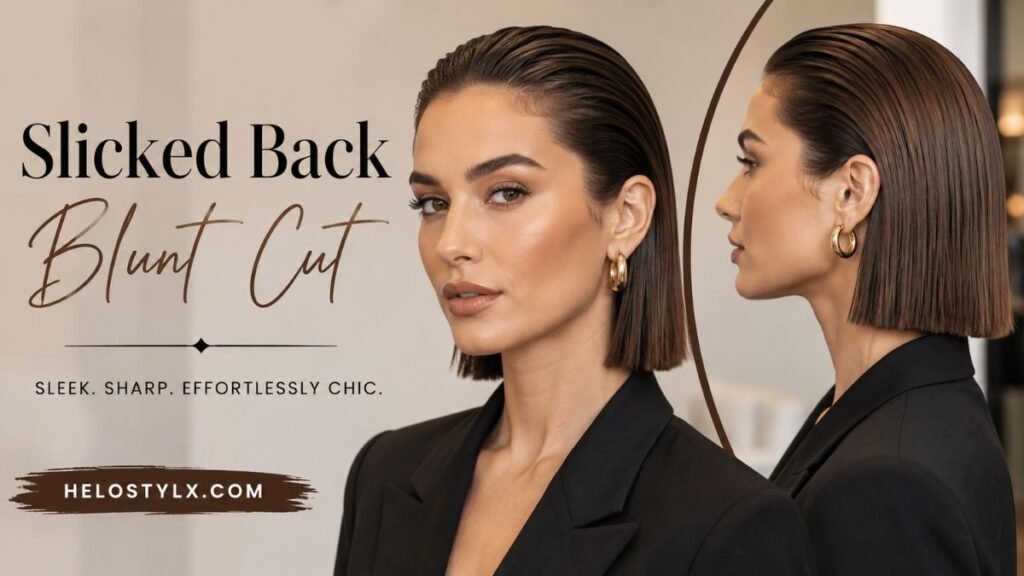
Hairstyle trends come and go, but few have taken over salon requests and social feeds quite like the slicked back blunt cut with flippy ends. It pairs the sleek, polished control of a slicked back finish with the playful bounce of soft, flipped-out ends, creating a look that feels both editorial and effortless.
If you’ve been scrolling through Pinterest boards or TikTok haircut transformations lately, chances are you’ve already seen this cut without knowing its name. This guide breaks down everything you need to know — from who it suits, to how to ask for it, style it, and maintain it — so you can decide if it’s the right move for your next salon visit.
What Is a Slicked Back Blunt Cut with Flippy Ends?
A slicked back blunt cut with flippy ends is a precision haircut where the hair is cut in one clean, horizontal line, then styled smooth and close to the scalp before the ends flick outward or upward. The contrast between the sleekness on top and the movement at the bottom is what defines the look.
Unlike a traditional blunt bob that’s usually worn with a soft middle part and loose waves, this version leans into structure. The crown and mid-lengths are slicked back with little to no volume, while the blunt ends do all the visual work.
The style draws inspiration from ’90s and Y2K supermodel hair, particularly the sleek, wet-look styles paired with flicked ends that were popular on runways. It has been reimagined for modern hair texture trends, making it wearable for everyday life rather than just photoshoots.
Key characteristics of this haircut:
- One-length, blunt horizontal cut line (no heavy layering)
- Hair slicked back off the face, often without a defined part
- Ends styled to flip outward, upward, or under using a round brush or flat iron
- Works on a range of lengths, typically shoulder-length to collarbone-length
Why This Hairstyle Is So Popular
This cut has surged in popularity because it solves a common styling dilemma: how to look polished without looking stiff. The slicked-back section gives structure and sophistication, while the flipped ends inject personality and softness.
Social media has played a major role in its rise. Short-form video platforms are ideal for showcasing the “before and after” transformation of hair being slicked back and then flipped with a brush, which makes the technique highly shareable and easy to visualize.
There’s also a broader cultural shift toward low-maintenance glam — styles that look intentional and expensive but don’t require hours of effort. This haircut fits that demand perfectly, since it can be achieved with a blow-dryer, a round brush, and a few minutes of styling time.
Celebrity stylists and runway shows have also normalized the sleek-meets-textured aesthetic, which trickles down into mainstream salon requests within months. The result is a hairstyle that feels current without being tied to a fleeting micro-trend.
Who Looks Best with a Slicked Back Blunt Cut?
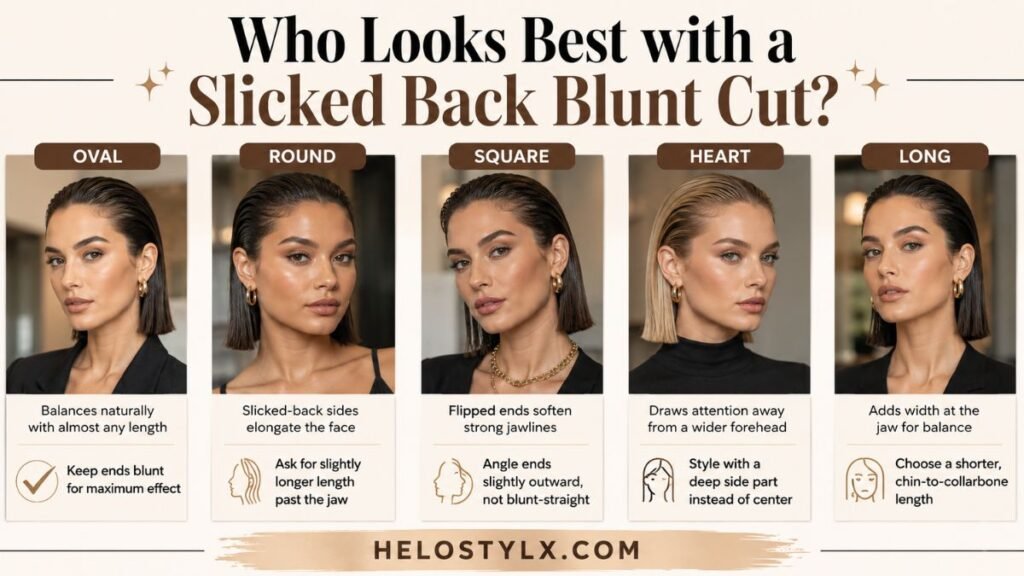
One of the biggest advantages of this haircut is its versatility across face shapes, hair types, and textures. That said, understanding how it interacts with your features helps you customize it for the most flattering result.
| Face Shape | Why It Works | Styling Note |
| Oval | Balances naturally with almost any length | Keep ends blunt for maximum effect |
| Round | Slicked-back sides elongate the face | Ask for slightly longer length past the jaw |
| Square | Flipped ends soften strong jawlines | Angle ends slightly outward, not blunt-straight |
| Heart | Draws attention away from a wider forehead | Style with a deep side part instead of center |
| Long | Adds width at the jaw for balance | Choose a shorter, chin-to-collarbone length |
Hair texture matters just as much as face shape. Fine hair benefits from the blunt cut because it creates the illusion of thickness, while thick or coarse hair holds the slicked-back shape and flipped ends with less product needed.
Wavy and curly hair types can absolutely wear this style, though it typically requires more heat styling or a keratin treatment to achieve the sleek, smooth base the look depends on.
Benefits of a Slicked Back Blunt Cut with Flippy Ends
This haircut isn’t just visually striking — it offers practical advantages that make it worth considering for your next cut.
- Low daily styling time: Once cut correctly, the shape does most of the work, requiring only a quick blow-dry and brush session.
- Adds the appearance of density: Blunt ends create an optical illusion of fuller, healthier-looking hair, even on finer strands.
- Face-framing flexibility: The flipped ends can be angled toward or away from the face to flatter different features.
- Transitions from day to night: A sleeker slick works for the office, while more pronounced flips suit evening looks.
- Reduces split ends over time: Because the cut relies on one clean line, regular blunt trims keep hair looking healthier for longer.
Expert tip: Stylists often recommend this cut to clients transitioning out of heavily layered styles, since the blunt line helps “reset” damaged or uneven ends while still looking intentional.
How to Ask Your Hairstylist for This Haircut
Communicating this haircut clearly is essential, since “blunt cut” and “flippy ends” can mean different things depending on the stylist. Being specific prevents miscommunication and a result you didn’t want.
What to say and show your stylist:
- Ask for a “one-length blunt cut” — specify no layers unless you want soft interior layering for movement.
- Mention you want the length to sit between the collarbone and shoulders, or specify your preferred length.
- Show reference photos of both the slicked-back styling and the flipped-end shape, since photos communicate far more accurately than words alone.
- Ask whether your hair texture will need a keratin treatment, blow-dry cream, or specific finishing tools to hold the slick effect.
- Clarify if you want a middle part, no part, or a deep side part built into the cut.
Helpful phrases to use:
- “I want a blunt, one-length cut with no layers.”
- “I’d like the ends styled to flip out, not curl under.”
- “Can we keep enough length to slick the top back smoothly?”
Also Read This : 15 Best Short Layered Hairstyles to Try in 2026 (Pixies, Bobs & Shags)
How to Style a Slicked Back Blunt Cut with Flippy Ends
Getting the signature look at home comes down to technique more than product quantity. Follow this step-by-step approach for a salon-quality finish.
- Start on damp hair. Apply a heat protectant and a lightweight smoothing cream from roots to ends.
- Blow-dry while slicking back. Using a paddle brush or your fingers, direct the hair backward and away from the face as you dry, focusing airflow along the hair shaft to boost shine.
- Smooth the crown and mid-lengths. Once mostly dry, use a fine-tooth comb or brush to press the top section flat against the scalp.
- Flip the ends with a round brush. Take one-inch sections of the ends and roll them outward or upward using a round brush and blow-dryer, holding for a few seconds before releasing.
- Finish with a flat iron for precision. For a crisper flip, clamp the ends with a flat iron and rotate the wrist slightly outward as you glide down.
- Set with a light-hold spray. Mist a flexible-hold spray over the ends only, avoiding the slicked-back section to prevent stiffness.
Key takeaway: The slicked-back section should look smooth and matte-to-satin, not wet or crunchy, while the ends should have visible movement and shine.
Best Hair Products for This Hairstyle

Product choice directly affects how well this style holds and how healthy your hair looks over time. Here’s a breakdown of the essentials.
| Product Type | Purpose | Best For |
| Smoothing cream or serum | Tames frizz for the slicked-back base | All hair types |
| Strong-hold gel | Keeps the crown flat and sleek | Fine to medium hair |
| Heat protectant spray | Shields hair during blow-drying and flat ironing | All hair types |
| Round brush (boar bristle) | Adds shine while flipping ends | Medium to thick hair |
| Flexible-hold hairspray | Locks the flip without stiffness | All hair types |
| Dry shampoo | Refreshes roots between washes for restyling | Oily or fine hair |
Expert tip: Apply gel to damp hair for the slicked-back section, but save any cream or serum for the ends only — mixing heavy products throughout can weigh down the flip and prevent it from holding shape.
Styling Tips to Make the Look Last All Day
Even a well-styled cut needs a little reinforcement to survive a full workday or night out. These techniques help the shape hold without needing a midday touch-up.
- Use a boar bristle brush for touch-ups. It redistributes natural oils and smooths flyaways without disturbing the flip.
- Sleep with a silk or satin pillowcase. This reduces friction that can cause frizz or flatten the ends overnight.
- Carry a travel-size flat iron. A quick 10-second reflip on the ends restores shape instantly.
- Avoid touching the crown throughout the day. Repeated touching can create bumps or loosen the slicked-back section.
- Set with a light mist, not a heavy spray. Heavy hairspray can make the flipped ends look stiff rather than soft and natural.
Different Variations of the Slicked Back Blunt Cut with Flippy Ends
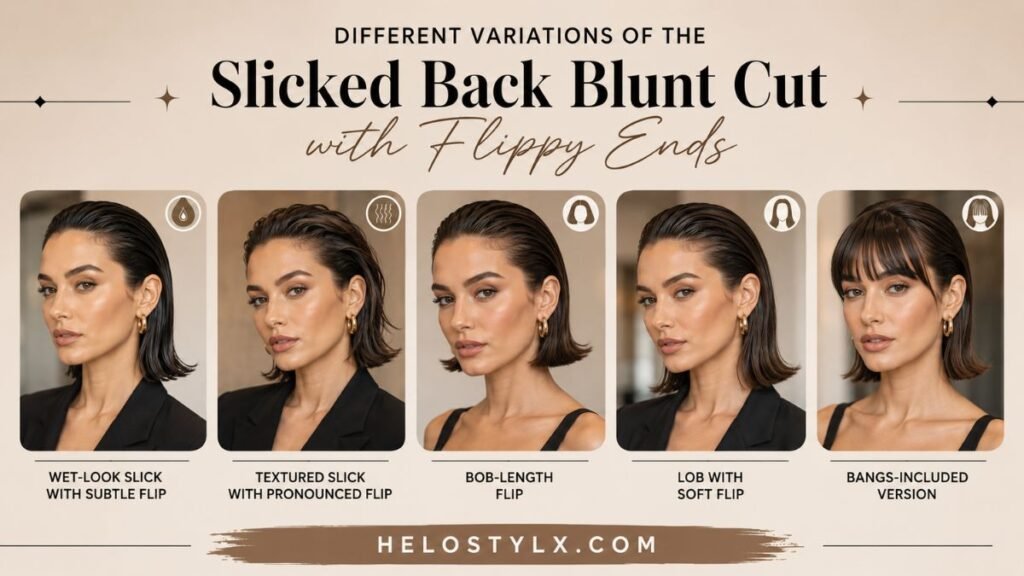
This haircut is far from one-size-fits-all. Depending on your styling preference and hair length, you can adapt it in several directions.
- Wet-look slick with subtle flip: A more dramatic, glossy slicked-back top paired with a barely-there flip at the ends, popular for red carpet-inspired looks.
- Textured slick with pronounced flip: A slightly looser, more lived-in top with strongly flipped ends for a casual, editorial feel.
- Bob-length flip: A shorter version that hits at the chin, delivering a bolder, more graphic silhouette.
- Lob (long bob) with soft flip: A longer take that keeps more length while still incorporating the blunt line and flipped ends.
- Bangs-included version: Paired with blunt or curtain bangs for a more retro, French-girl aesthetic.
Key takeaway: The shorter the length, the more graphic and dramatic the flip appears, while longer versions read as softer and more subtle.
Common Mistakes to Avoid
Even a well-designed haircut can go wrong with the wrong technique or product approach. Watch out for these frequent missteps.
- Overloading the slicked-back section with gel, which can create flaking or a greasy appearance by midday.
- Using a curling iron instead of a round brush or flat iron, which tends to create curls rather than the sharp, flipped shape.
- Skipping heat protectant, since the style relies on repeated blow-drying and flat ironing that can damage unprotected hair.
- Choosing the wrong length for your face shape, which can make the flip look awkward rather than flattering.
- Not communicating clearly with your stylist, resulting in a cut that’s too layered or too short to achieve the intended shape.
How to Maintain the Haircut
Because this style depends on a crisp, blunt line, upkeep is more important than with looser, layered cuts. A little consistency goes a long way toward preserving the shape.
- Trim every 6–8 weeks. Blunt lines grow out and soften faster than layered cuts, so regular trims are essential to keep the sharp silhouette.
- Deep condition weekly. Frequent heat styling can dry out ends, so a weekly treatment helps maintain shine and flexibility for flipping.
- Use heat tools on a moderate setting. High heat isn’t necessary to achieve the flip and can accelerate damage over time.
- Book a keratin or smoothing treatment if needed. For wavy or curly textures, this can significantly reduce daily styling time.
- Rotate your part occasionally. Since the style is often worn without a defined part, changing where you begin the slick-back can prevent long-term strain on the same hairline area.
Slicked Back Blunt Cut vs. Classic Blunt Bob
While both styles share the same precise, one-length cutting technique, they differ significantly in styling and overall vibe.
| Feature | Slicked Back Blunt Cut with Flippy Ends | Classic Blunt Bob |
| Styling approach | Slicked back top, flipped ends | Center or side part, loose waves |
| Overall vibe | Polished, editorial, modern | Soft, classic, versatile |
| Daily maintenance | Blow-dry and brush technique required | Can be worn air-dried |
| Best for | Those wanting structure and drama | Those wanting a low-effort everyday look |
| Length flexibility | Chin to collarbone typically | Chin to shoulder, widely adaptable |
Choosing between the two often comes down to lifestyle. If you enjoy a slightly more involved styling routine and want a distinctive, statement look, the slicked back version is the better fit. If you prefer minimal effort and versatility, the classic blunt bob remains a reliable choice.
Is This Haircut Worth Trying?
For most people, the answer is yes — provided you’re comfortable with a small learning curve when it comes to styling. The technique takes a few practice sessions to master, particularly the round-brush flip, but the payoff is a distinctive, salon-fresh look you can recreate at home.
It’s especially worth trying if you’re looking to move away from heavy layers, want a haircut that photographs well, or are drawn to the sleek-meets-textured aesthetic currently dominating runways and red carpets. It also suits anyone who wants their hair to look consistently polished without a lengthy morning routine.
If you have very limited time for styling or strongly prefer air-drying, it may be worth pairing this cut with a keratin treatment first, or opting for the classic blunt bob instead for lower daily effort.
Recommended visual reference:
Conclusion
The slicked back blunt cut with flippy ends earns its popularity by balancing two opposing energies — sleek control and playful movement — into one cohesive, wearable style. It flatters a wide range of face shapes and hair textures while remaining relatively low-maintenance once you’ve nailed the styling technique.
Whether you’re chasing a runway-inspired refresh or simply want a haircut that feels current and polished, this cut delivers striking results with minimal daily effort. With the right cut, products, and a little practice, it’s a trend well worth bringing to your next salon appointment.
