
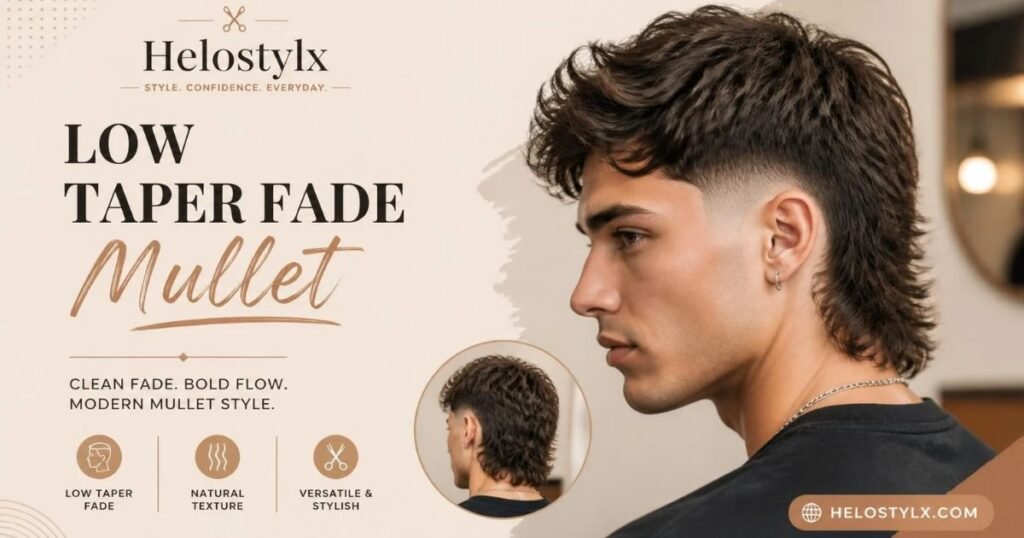
If you’ve been scrolling through barbershop inspiration lately, you’ve probably noticed the same haircut popping up again and again: the low taper fade mullet. It’s the perfect middle ground between “I want something different” and “I still need to look put-together for work on Monday.” Short and clean on the sides, a little wild and long in the back — this cut gives you the best of both worlds.
In this guide, we’re breaking down everything you need to know about the low taper fade mullet: the best variations, how it works with different hair types and face shapes, exactly what to say to your barber, and how to style it yourself at home. By the end, you’ll know precisely why this cut has become one of the most requested styles of the year — and whether it’s right for you.
What Is a Low Taper Fade Mullet?
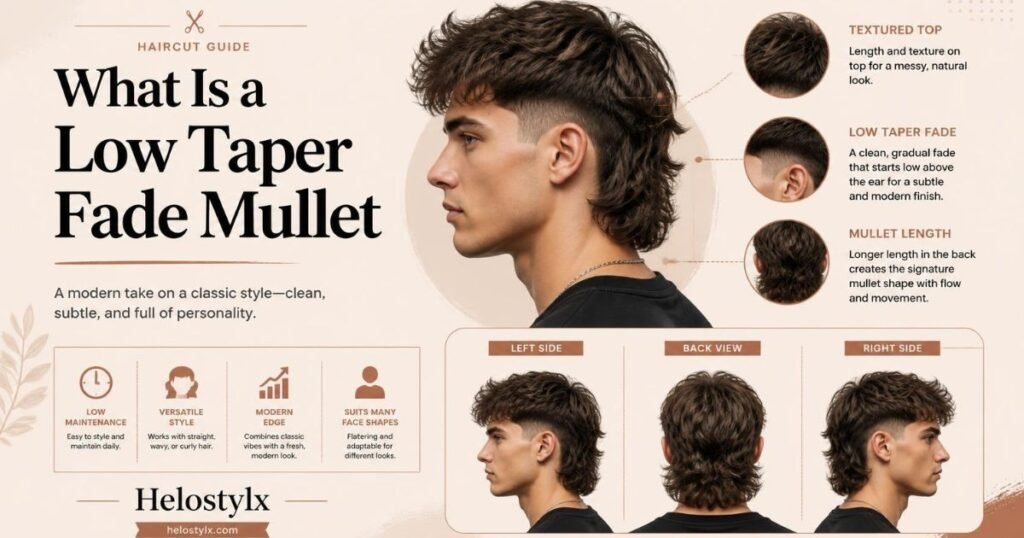
A low taper fade mullet combines two classic barbering techniques into one modern silhouette. The “low taper” part refers to fade placement that starts just above the ears and neckline, gradually blending hair length into the skin without going too high up the head. Unlike a high or mid fade, a low fade haircut keeps more length around the sides, which makes it a subtler, more versatile fade for everyday wear.
The “mullet” part is where things get fun. Instead of an even length all over, the top and crown stay noticeably longer, gradually transitioning into an even longer section at the back and nape. This is what gives the modern mullet its signature “business up front, party in the back” energy — except today’s version is far more refined than the mullets of decades past.
Put the two together, and you get a taper fade mullet that’s sharp at the hairline and sideburns, seamless through the neckline, and full of natural movement on top. It’s edgy without being over-the-top, and professional enough to survive a client meeting.
Why Choose a Low Taper Fade Mullet Over Other Mullet Styles?
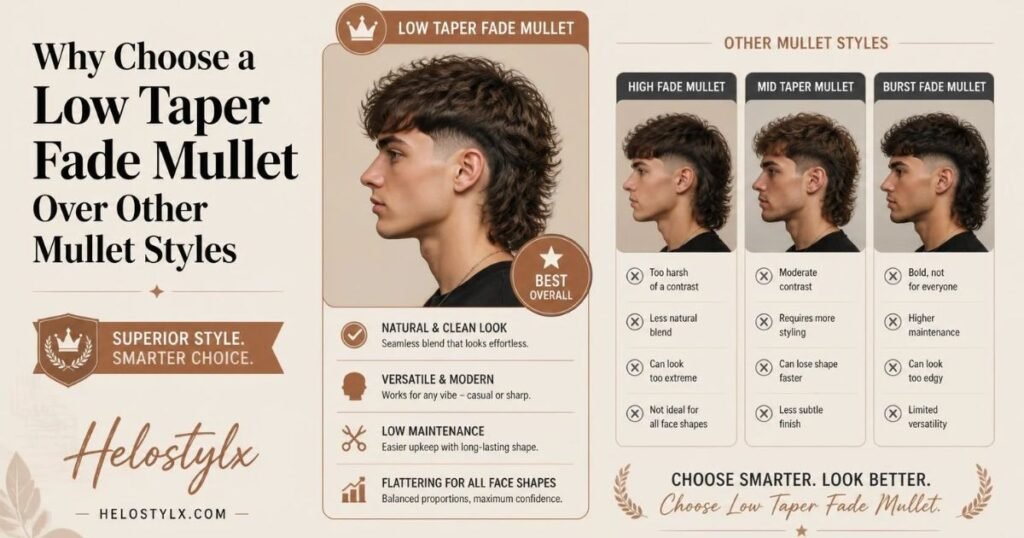
Not all mullets are created equal, and the low taper version has some clear advantages over its high-fade or undercut cousins.
It’s more versatile for different environments. A low fade mullet reads as trendy rather than rebellious. That subtlety makes it a genuinely viable business mullet option — something you can’t always say for a high-contrast skin fade mullet.
It grows out gracefully. Because the fade starts lower, the grow-out phase is far less noticeable. You won’t need to rush back to the chair every two weeks just to avoid an awkward halfway-grown line.
It works with more face shapes and hair textures. A low taper haircut softens the transition between short and long hair, which means it flatters a wider range of face shape and hair texture combinations than more extreme fades do.
It’s easier to maintain. With less dramatic contrast, small amounts of natural regrowth blend in rather than standing out — perfect if you don’t want to be in the barber’s chair every other week.
In short: if you want the mullet’s rebellious spirit without sacrificing polish, the low taper version is the smartest way to get it.
Best Low Taper Fade Mullet Styles and Variations
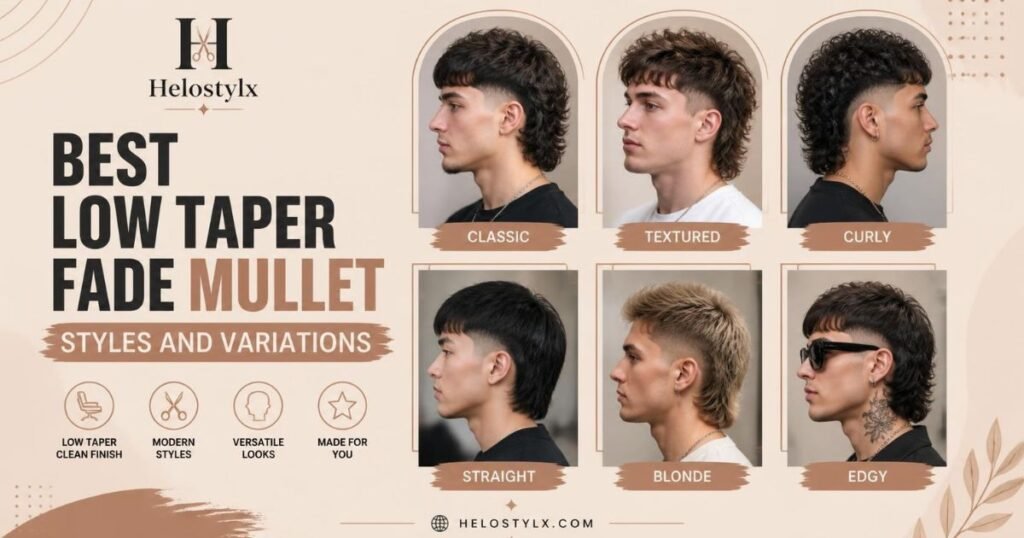
One of the best things about the low taper fade mullet is how many ways you can wear it. Here are the standout variations worth showing your barber.
Textured Mullet
A textured mullet uses point cutting and texturizing shears throughout the top and back to break up bulk and create movement. This is the go-to choice if your hair tends to sit flat or look heavy.
Curly Mullet
For natural curls or coils, a curly mullet allows the fade to stay tight and defined while the curl pattern on top and in back does all the visual work. Curls add volume and texture that a straight mullet simply can’t replicate.
Shaggy Mullet
The shaggy mullet leans into soft layering and a slightly undone, tousled finish. It’s low-maintenance, effortlessly cool, and works especially well with wavy or slightly textured hair.
Wolf Cut Mullet
A hybrid of a shag and a mullet, the wolf cut mullet adds heavy layering and volume through the crown for a fuller, more voluminous look. It’s a favorite for anyone chasing serious crown volume.
Feathered Mullet
The feathered mullet uses soft, blended layers that feather outward, especially around the sides and back. This variation feels a bit more retro-modern and works beautifully on fine to medium hair.
Surfer Mullet
Sun-kissed, wavy, and relaxed — the surfer mullet pairs a low fade with longer, wavier lengths on top for that beachy, laid-back vibe.
Professional Mullet
If you need something office-appropriate, the professional mullet keeps the top shorter and the back length more conservative, so the mullet reads as “polished” rather than “party.”
Short vs. Long: Which Length Is Right for You?
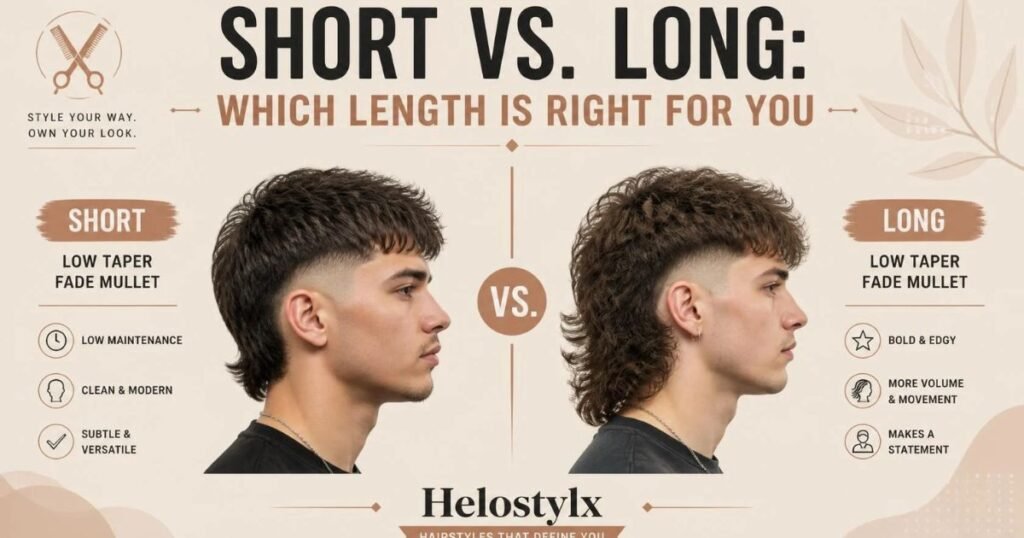
Length is where the low taper fade mullet gets personalized. Here’s how to think about it.
Short Mullet
- Best for: first-timers, workplaces with stricter dress codes, thick or curly hair that adds volume quickly
- Top length stays close to 1.5–2 inches; back length just grazes the collar
- Lower maintenance and easier to grow out later
Medium Length Mullet
- Best for: most face shapes and the widest range of hair types
- Enough length on top to style with texture, with a clearly defined but not extreme back section
- The sweet spot for anyone wanting a noticeable mullet without going dramatic
Long Mullet
- Best for: thick or wavy hair, and anyone confident about committing to the style
- Back length extends well past the collar, and top length allows for serious styling versatility
- Requires more upkeep, especially around the fade line
If you’re unsure, start with a medium length mullet. It gives you flexibility, and your barber can always cut it shorter — but they can’t add length back overnight.
Low Taper Fade Mullet for Straight, Wavy, Curly, and Thick Hair
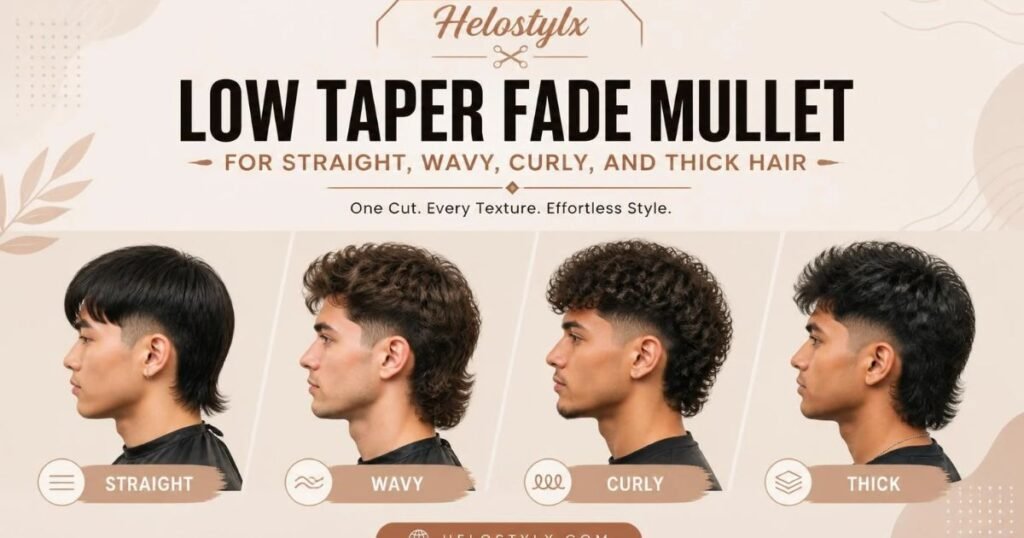
Your hair texture dramatically changes how a low taper fade mullet looks and behaves. Here’s what to expect and request based on your hair type.
Low Taper Fade for Straight Hair
Straight strands show every line clearly, which means precision is everything. Ask your barber for scissor over comb work through the back to avoid a blunt, helmet-like edge. Point cutting on top adds subtle texture so the style doesn’t fall flat.
Wavy Low Taper Fade
Waves are arguably the easiest texture to work with here. The natural bend adds volume and separation without much effort. A layered mullet cut enhances the wave pattern, giving you natural movement with minimal styling.
Curly Low Taper Fade
Curls bring built-in volume, which pairs beautifully with the contrast of a low fade. Ask for the sides tapered with clippers while the top and back are cut dry (or on stretched hair) to account for shrinkage — a mistake that trips up a lot of first-time curly mullet clients.
Low Taper Fade for Thick Hair
Thick hair holds shape well but can get bulky fast. Heavy texturizing shears through the mid-lengths remove weight while preserving length, keeping the mullet from looking like a solid block of hair.
Low Taper Fade for Fine Hair
Fine hair needs the opposite approach — minimal thinning, since removing too much weight can make the style look sparse. Soft layering and a slightly shorter back length help create the illusion of extra density.
Which Face Shapes Suit a Low Taper Fade Mullet Best?
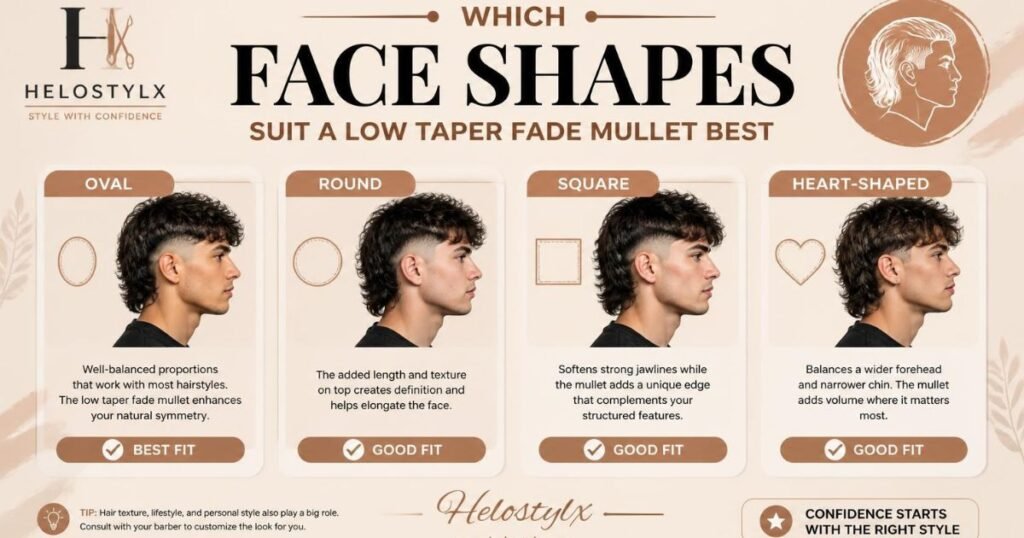
The right styling choices can make a low taper fade mullet work for nearly any face shape — but a few small adjustments make a big difference.
Round Face Add height and volume on top while keeping the sides tight. This visually elongates the face. Avoid excessive width at the crown.
Square Face Softer, feathered layers around the temples reduce the sharpness of a strong jawline. A textured top with movement complements angular features nicely.
Oval Face Good news — oval faces can wear almost any version of this cut. Balance is already built in, so focus on texture and personal style rather than corrective shaping.
Long Face Keep the top length more moderate rather than very tall, and let the sides carry a bit more visual width. This helps shorten the overall vertical line of the face.
Rectangular Face Similar to long faces, avoid excessive height on top. A fuller fringe or side-swept top section adds horizontal balance.
Diamond Face Soft, layered movement around the cheekbones softens angularity, while a slightly fuller crown balances a narrower forehead and chin.
Also Read This : Taper Low Burst Fade: Best Styles & Barber Tips
How to Ask Your Barber for the Perfect Low Taper Fade Mullet
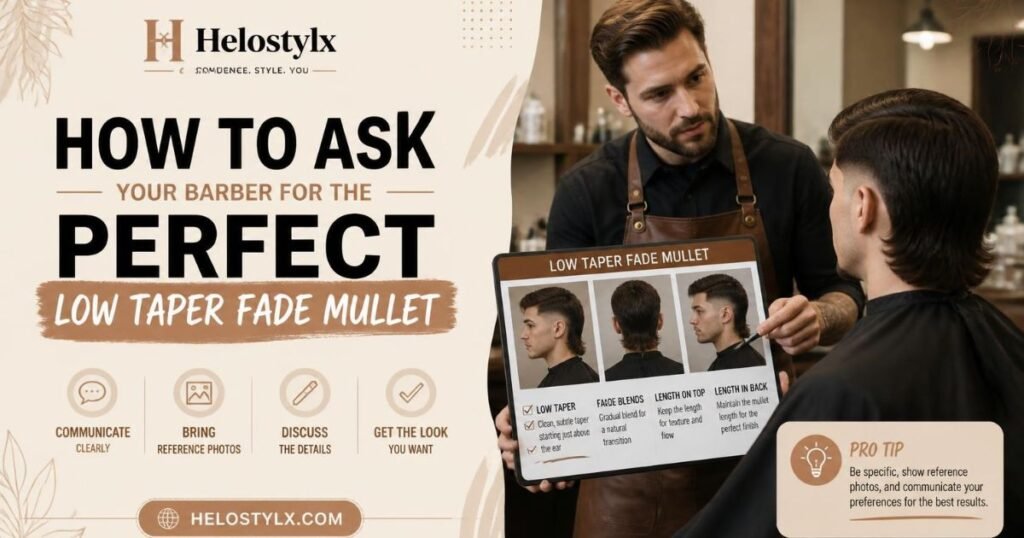
Communication makes or breaks this haircut. Here’s exactly how to walk into the shop prepared.
- Name the fade height first. Say clearly: “I want a low fade, starting just above my ears, not up near my temples.”
- Specify your clipper guard preference. A common low taper starts around a #1 or #1.5 at the nape and blends to a #3 or #4 through the mid-section.
- Describe the back and top length. Be specific: “Leave the back long enough to touch my collar” or “keep the top around 3 inches with texture.”
- Mention your sideburns. Ask whether you want them tapered to match the fade or kept slightly fuller.
- Bring reference photos. Even the best communication benefits from a visual. Save 2–3 images showing the exact fade placement and back length you want.
- Ask about texturizing shears. If you want a shaggier, less blocky finish, request point cutting through the crown and back.
A good barber will also check your hairline, crown volume, and natural texture before finalizing the cut — so don’t be surprised if they suggest small tweaks based on how your hair actually grows.
How to Style a Low Taper Fade Mullet at Home, Step by Step
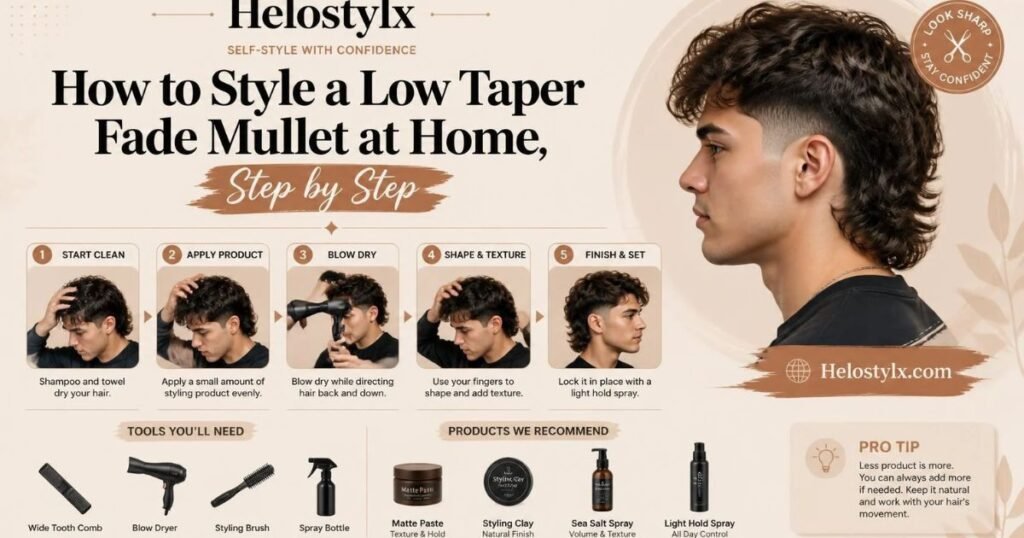
Once you’ve got the cut, styling it well takes just a few minutes.
Step 1: Start with damp hair. Towel-dry until hair is about 70% dry — too wet, and product won’t distribute evenly.
Step 2: Apply the right product for your texture.
- Straight or fine hair: a lightweight sea salt spray or texturizing powder
- Wavy or curly hair: a curl cream or light mousse to define natural pattern
- Thick hair: a matte clay or paste for control without heaviness
Step 3: Rough-dry with your fingers. Use a blow dryer on medium heat, lifting at the roots to build natural volume and movement. Focus airflow at the crown for lift.
Step 4: Define the top. Use your fingers (not a comb) to separate sections and create natural, textured finish rather than a stiff, uniform look.
Step 5: Shape the back. Lightly comb or finger-style the back section so it lies naturally, following your neck’s shape rather than sticking out.
Step 6: Set with a light-hold product. A flexible spray or light pomade locks in the style without making it feel crunchy or overly polished.
Step 7: Sleep-proof it. If you wake up with a flattened crown, a quick spritz of water and a 30-second reshape with your fingers usually fixes it.
How Often Should You Trim and Maintain It?
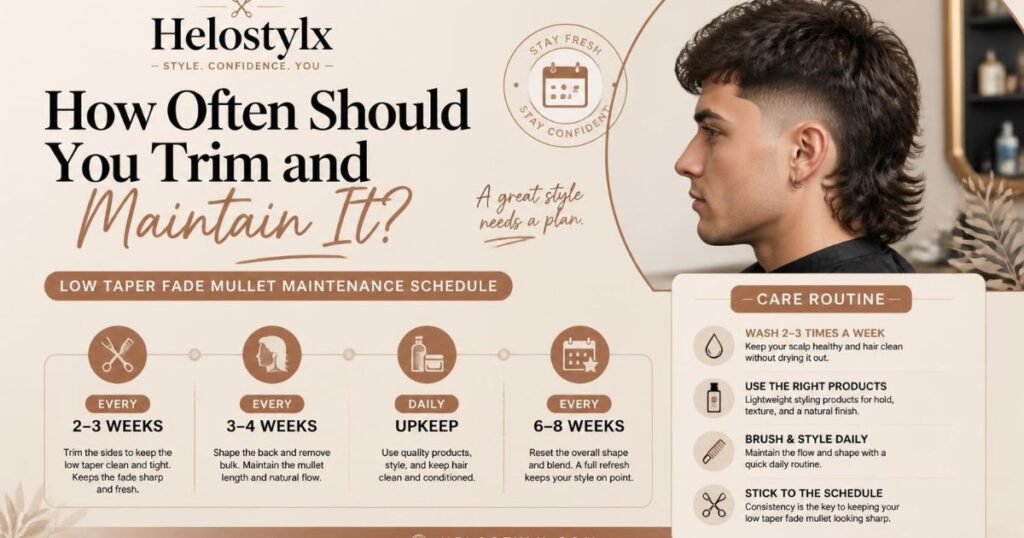
Maintenance is where the low taper fade mullet really shines compared to other fades.
- Fade touch-ups: Every 3–4 weeks to keep the tapered sides and tapered back looking sharp and intentional
- Top trims: Every 6–8 weeks, just enough to maintain shape without cutting away the length that defines the mullet
- Back length: Trim only when split ends appear or the shape starts looking uneven — this is the part you’re growing out, after all
Between appointments, keep hair healthy with regular conditioning, since the longer sections in a mullet are more prone to dryness and breakage than a uniformly short cut. If you’re actively growing out length, ask your barber to focus fade maintenance on the sides only, leaving the top and back untouched.
Low Taper Fade Mullet FAQs
Is a low taper fade mullet professional enough for work?
Yes — the shorter or medium-length version reads as a clean, well-groomed business mullet.
Does a low taper fade mullet work for curly hair?
Yes, curls add natural volume that pairs perfectly with a curly mullet‘s low fade contrast.
How long does hair need to be to get a low taper fade mullet?
At least 3–4 inches on top and 2–3 inches in back for a proper modern mullet haircut.
What’s the difference between a low fade and a regular taper fade mullet?
A low fade blends down to the skin near the ears; a regular taper fade blends length without going to skin.
Final Takeaway
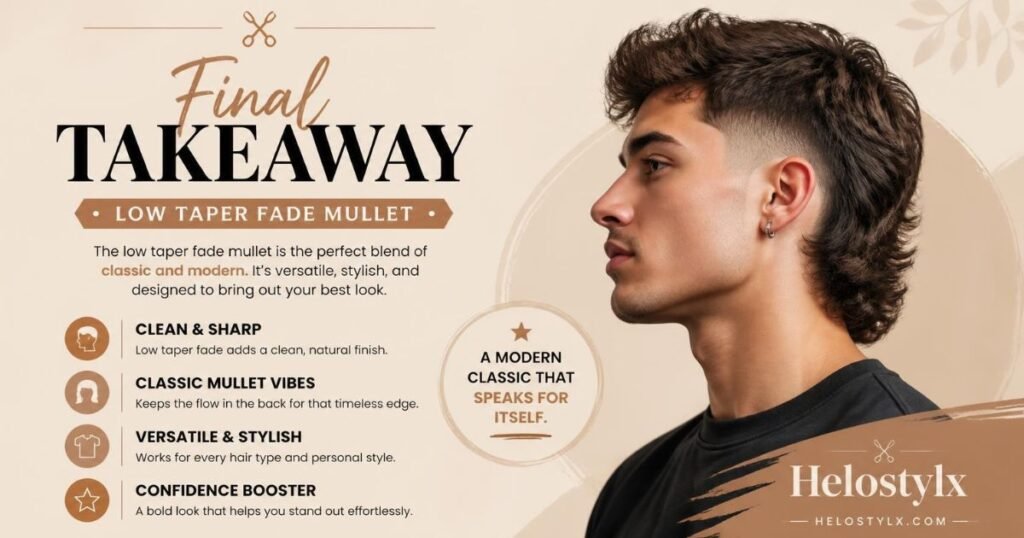
The low taper fade mullet earns its popularity honestly — it’s sharp, versatile, and adaptable to nearly any hair texture or face shape. Whether you’re drawn to a shaggy, textured finish or a cleaner, professional mullet, the key is clear communication with your barber and a maintenance routine that fits your lifestyle.
Start with the fade height and back length that match your comfort level, be specific about texture and volume, and don’t be afraid to experiment as your hair grows. Done right, a low taper fade mullet isn’t just a haircut — it’s a statement that works just as well in the boardroom as it does on the weekend.
