
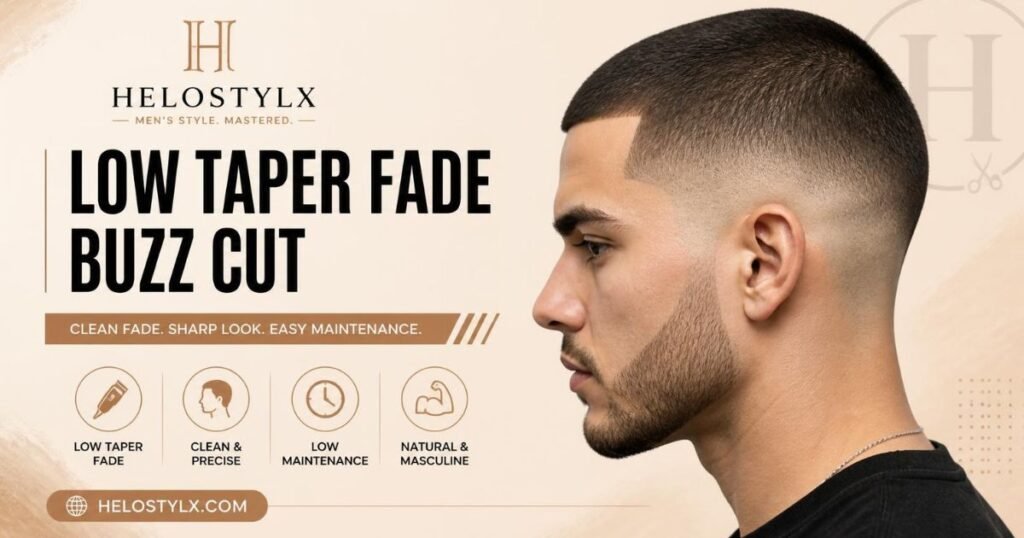
If you’re tired of long styling routines and want something sharp, clean, and genuinely low-maintenance, the low taper fade buzz cut is probably the haircut you’ve been picturing in your head. It’s the quiet MVP of modern men’s haircuts — subtle enough for the office, sharp enough for the weekend, and built to grow out gracefully instead of looking messy after ten days.
This guide breaks down everything you need to know: the best styles, how to pick your clipper guard, how it works with straight, wavy, curly, and coily hair, which version suits your face shape, and exactly how to explain it to your barber so you never leave the chair disappointed.
What Is a Low Taper Fade Buzz Cut?
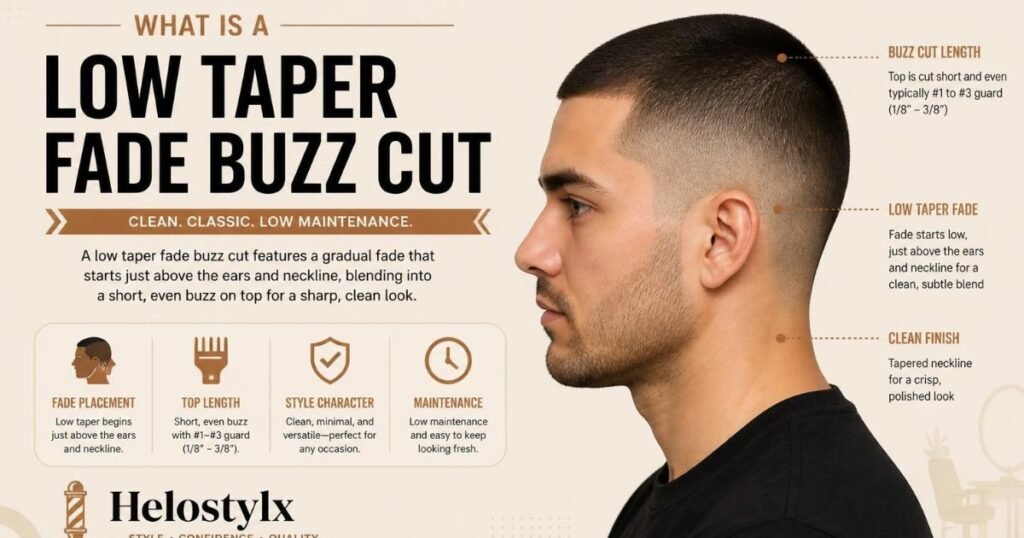
A low taper fade buzz cut combines two things: a buzz cut (short, even length all over, usually clipped with a single guard) and a taper fade (a gradual fade placement that starts low, near the hairline, and blends the sides and back down to bare skin or near-skin around the ears and neckline).
Unlike a mid fade or high fade, which move the fade placement up toward the temples or crown, a low fade haircut keeps the blend close to the hairline. That means:
- More hair stays visible on the sides overall
- The fade blend is subtle rather than dramatic
- It reads as clean and professional rather than “styled”
- It suits nearly every hair type, density, and face shape
In short, it’s a tapered buzz cut with just enough definition around the edges to look intentional — not just “short hair,” but a genuine haircut with structure.
Best Low Taper Fade Buzz Cut Styles
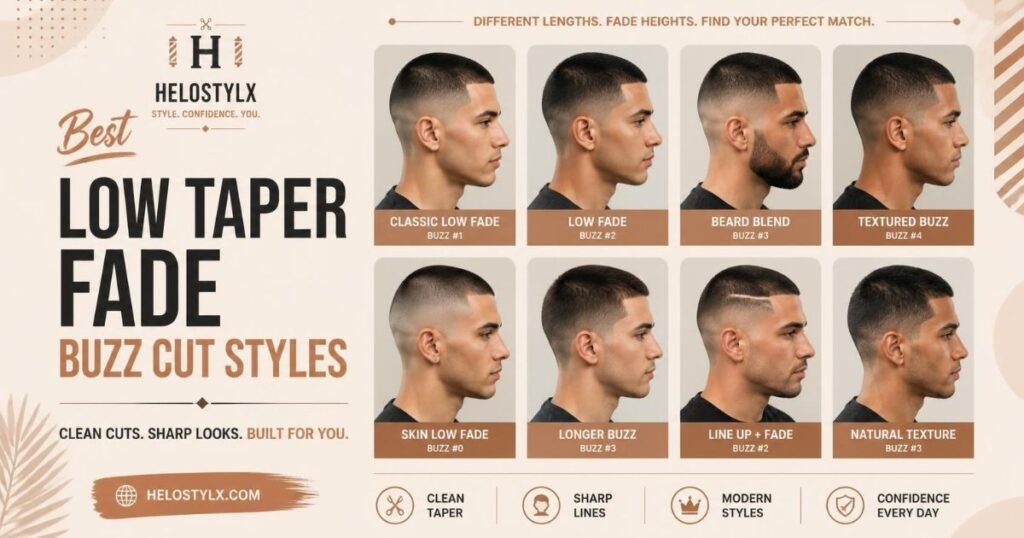
Not every low taper fade buzz cut looks the same. Small changes in top length, texture, and finishing details create very different vibes. Here are the styles worth showing your barber.
1. Classic Buzz Cut With a Low Taper
The most straightforward version: uniform length on top (guard #2–#4), a low fade blending into the sideburns and neckline, and clean edges. This is the go-to for a classic buzz cut feel with just a bit more polish.
2. Textured Buzz Cut
If your hair has natural movement or you want a slightly more dimensional look, ask for a textured buzz cut. The barber uses scissors-over-comb or point-cutting on top to break up the uniformity, while the low taper fade stays clean on the sides.
3. Buzz Cut With Line-Up
Adding a crisp line-up along the hairline and temples turns a basic buzz into a sharper, more defined look. A buzz cut with line-up is especially popular for guys who want a barbershop-fresh appearance that lasts.
4. Buzz Cut With Beard
Pairing a low taper fade buzz cut with a well-groomed beard creates balance — the fade tapers the sides while the beard adds fullness to the jawline. This combo works particularly well for rounder or narrower face shapes.
5. Modern Buzz Cut With Skin Fade Accent
A modern buzz cut variation keeps the top slightly longer (guard #4–#5) while pushing the very bottom of the fade to bare skin for extra contrast, without raising the fade placement too high.
6. Curly or Coily Buzz Cut
For textured hair, a curly buzz cut or coily buzz cut keeps the curl pattern visible on top (usually guard #3–#5, since curls shrink) while the low taper keeps the sides neat without fighting the natural texture.
Choosing Your Buzz Length: A Clipper Guard Guide
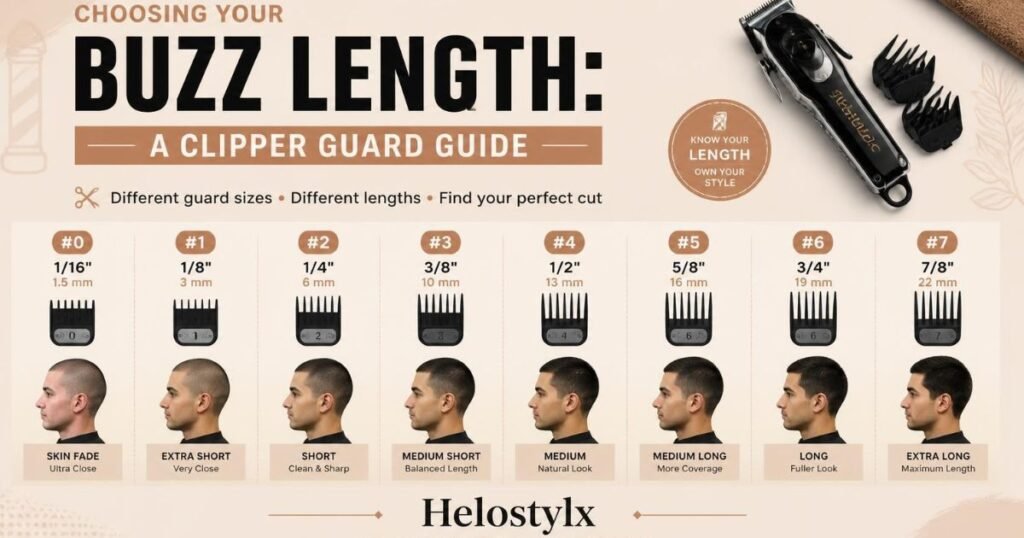
The single biggest factor in how your buzz cut looks is the guard number you choose for the top. Here’s a simple breakdown of clipper guard sizes and what they deliver:
- Guard #1 (1/8 inch): Nearly bare skin. Extremely low-maintenance, high contrast against the fade.
- Guard #2 (1/4 inch): The classic short buzz length. Clean, sharp, minimal styling needed.
- Guard #3 (3/8 inch): A little more visible hair length and texture; still very low-maintenance.
- Guard #4 (1/2 inch): Enough hair to add slight texture or a light quiff with product.
- Guard #5 (5/8 inch): More versatility on top, ideal for curly or coily hair that shrinks.
A general rule: the shorter your top length, the more contrast you’ll get against the fade blend, and the longer it takes to notice regrowth. Guys with thinning hair or receding hairlines often prefer #1–#2 for a cleaner overall look, while guys who want a bit of styling flexibility go #3–#5.
Your barber will also use guard sizing for the fade height and fade placement on the sides — but for a genuinely low fade, expect the transition zone to sit just above the ears rather than up near the temples.
Low Taper Fade Buzz Cut for Straight, Wavy, Curly, and Coily Hair
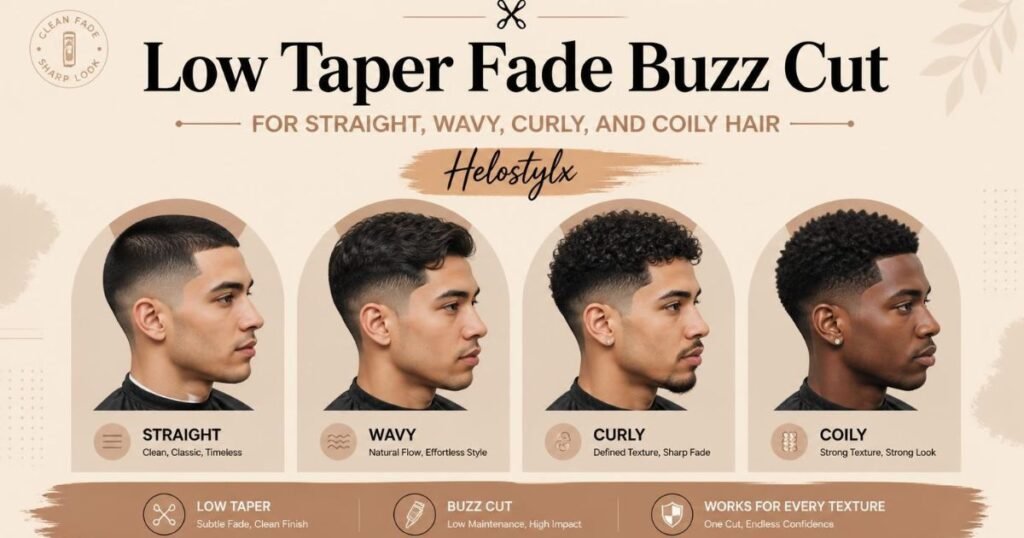
One of the best things about this cut is that it works across virtually every hair type. Here’s how to adapt it.
Straight Hair
Straight hair takes the fade blend extremely well because there’s no texture to interrupt the gradual fade. A low taper fade haircut on straight hair looks crisp with almost no styling required — just a light matte product if you want to knock down any shine.
Wavy Hair
Wavy hair adds natural texture on top even at short lengths. A guard #3–#4 buzz length lets the waves show through slightly, giving the cut more visual interest without losing the low-maintenance appeal.
Curly Hair
For a curly buzz cut, remember that curls shrink significantly once cut — a guard #3 on curly hair might look like a #1 once it dries. Ask your barber to buzz slightly longer than you think you need, then evaluate.
Coily Hair
A coily buzz cut benefits from slightly longer top lengths (guard #4–#5) to preserve definition and avoid an overly flat look. The low taper fade still works beautifully on coily hair — it simply requires a skilled hand with a T-blade or detail trimmer to blend density changes near the hairline and temples.
Best Low Taper Fade Buzz Cut for Your Face Shape
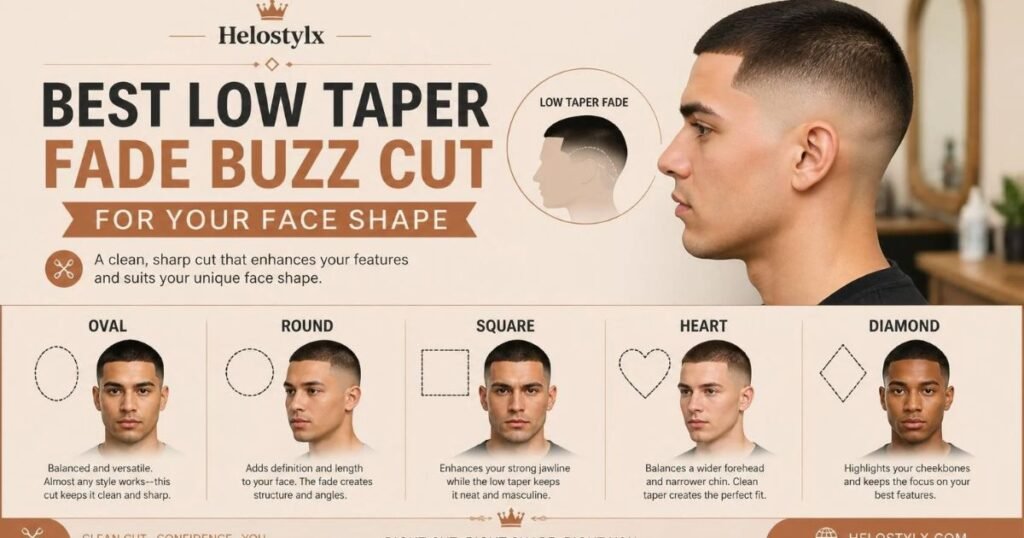
Face shape affects how much taper, top length, and edge definition will actually flatter you. Here’s a practical breakdown.
- Round Face: Choose a shorter top (guard #1–#2) with a defined crisp hairline. This adds visual length and avoids adding width. Pairing with light beard growth along the jaw also helps.
- Square Face: You can handle more texture on top (guard #3–#4). A soft line-up (rather than razor-sharp) will complement your strong jawline instead of over-emphasizing it.
- Oval Face: The most versatile shape — nearly any version of the low taper fade buzz cut works, from a classic buzz cut to a textured buzz cut with line-up.
- Long/Rectangular Face: Keep some length on top (guard #4–#5) to avoid elongating the face further. Avoid super-high contrast fades that draw the eye vertically.
- Diamond Face: A slightly textured top balances narrow temples and a pointed chin. Keep the taper placement low so it doesn’t compete with your cheekbones.
- Heart-Shaped Face: A low fade (not mid or high) keeps volume balanced, since higher fades can make a narrow chin look even smaller in proportion to the forehead.
Line-Ups and Shape-Ups: Getting the Edges Right
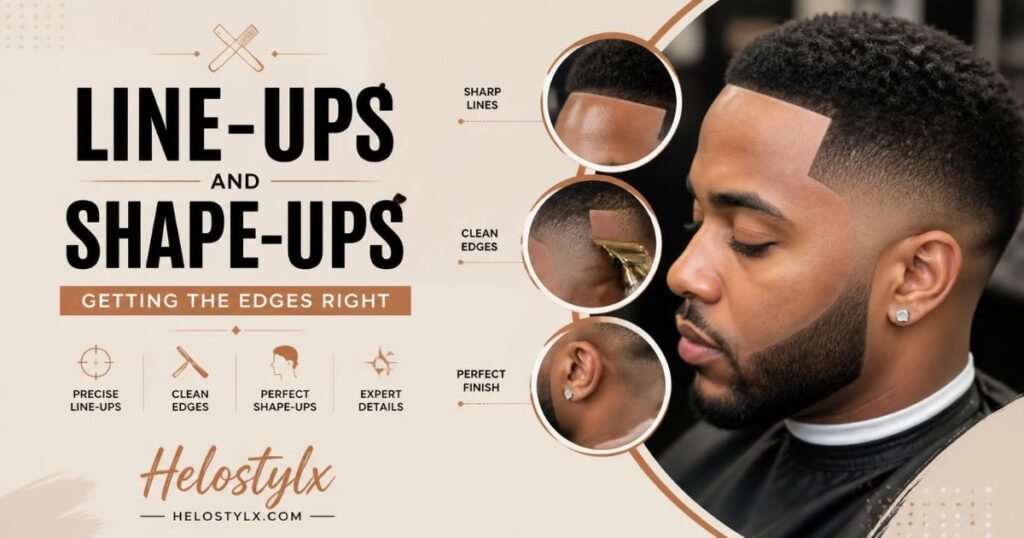
The difference between a good buzz cut and a great one often comes down to the edges. Here’s what your barber is actually doing during a shape-up:
- Hairline definition — using a T-blade or detail trimmer to create a straight or gently curved edge across the forehead.
- Temple cleanup — squaring off or rounding the temple area depending on your preference.
- Sideburn alignment — making sure both sideburns match in length and angle.
- Neckline shaping — a rounded or blocked neckline, cleaned up with bare-skin precision.
- Razor finish — some barbers finish the hairline and neckline with a straight razor for an ultra-crisp edge that lasts a few extra days.
If you want subtlety, ask for a soft line-up — the edges are defined but not razor-sharp, which tends to look more natural as it grows out. If you want maximum sharpness for an event or photos, ask for a crisp hairline with razor finishing.
Also Read This : Warrior Cut: The Trendiest Men’s Haircut of 2026
How to Ask Your Barber for a Low Taper Fade Buzz Cut
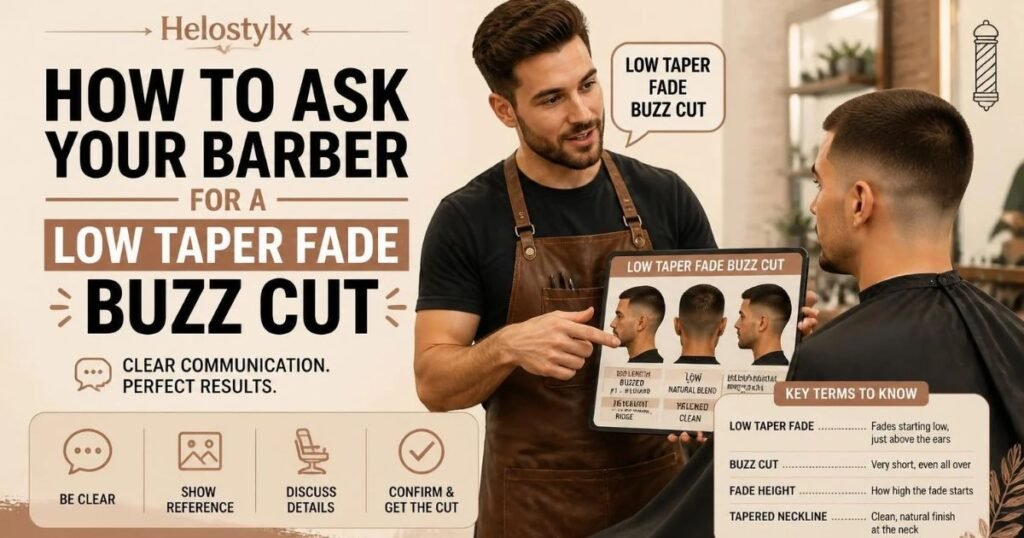
Miscommunication is the #1 reason people leave the barbershop disappointed. Use this script to get exactly what you want:
- “I want a low taper fade buzz cut — guard [your number] on top, blended into a low fade that starts just above the ears.”
- “Keep the fade placement low — I don’t want it climbing up toward my temples.”
- “Please leave [some/no] texture on top for a slightly textured buzz cut look.”
- “I’d like a [soft/crisp] line-up along the hairline and a [rounded/blocked] neckline.”
- “Please use clipper-over-comb around the crown so it doesn’t look too flat.”
Bring a reference photo if you can — even experienced barbers interpret “low taper fade” differently, and a photo removes the guesswork around fade height and blend style.
Low Taper Fade vs Mid Taper vs Skin Fade
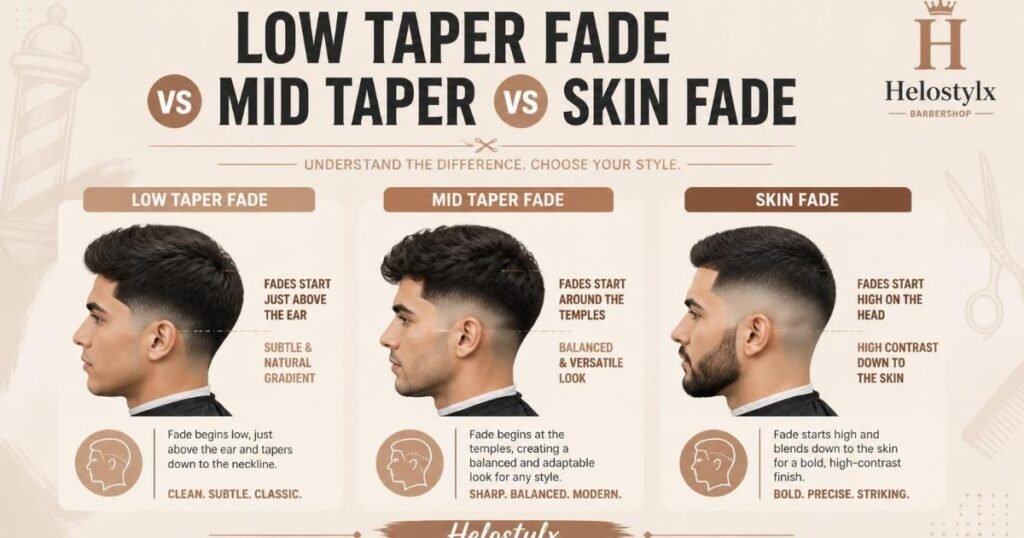
These three terms get mixed up constantly, so here’s the real difference:
| Fade Type | Fade Placement | Best For |
| Low taper fade | Starts just above the ears, close to the hairline | Office-friendly, subtle, classic looks |
| Mid fade | Starts around the middle of the sides, near the temples | More noticeable contrast, still versatile |
| High fade / skin fade | Starts high, near the top of the head, often to bare skin | Bold, modern, high-maintenance styling |
A low fade gives you the most hair coverage and the most gradual, natural-looking blend — which is exactly why it’s the safest and most office-friendly haircut on this list. A skin fade, by contrast, creates dramatic contrast between bare skin and the top length, which reads as edgier and requires more frequent touch-ups to stay sharp.
If you’re unsure which to choose, remember: low taper = subtle and professional, mid fade = balanced, skin fade = bold and high-contrast.
How to Maintain a Low Taper Fade Buzz Cut
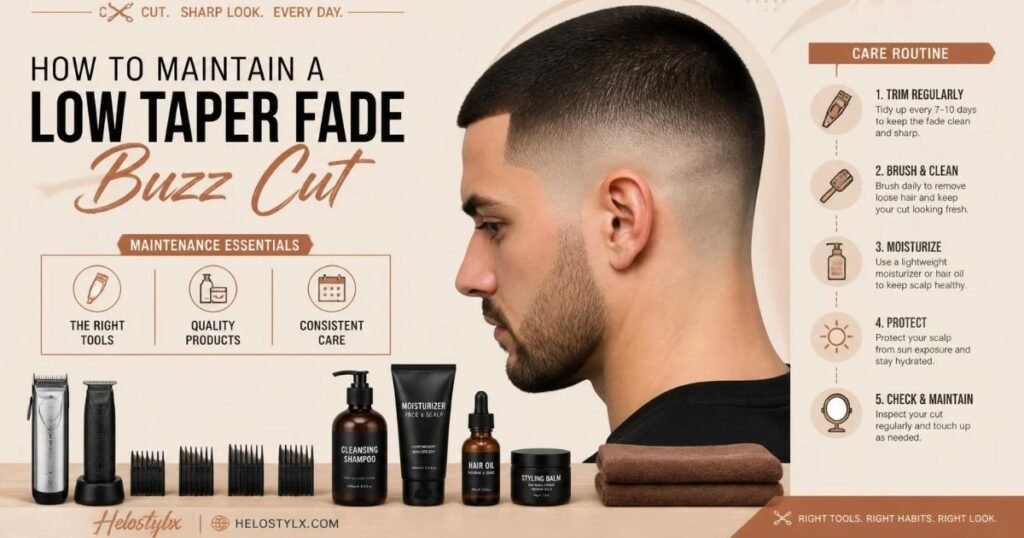
This cut is genuinely one of the most low-maintenance haircuts available — but “low-maintenance” doesn’t mean “no maintenance.” Here’s how to keep it looking fresh.
- Trim every 2–3 weeks. Buzz cuts grow out fast at the roots, and the fade blend softens quickly. Regular trims keep the fade blend sharp.
- Invest in your own clippers. If you’re comfortable doing basic upkeep at home, a clipper guard set lets you maintain top length between barber visits.
- Moisturize your scalp. Short hair exposes more scalp, so a light daily moisturizer or oil prevents dryness and flaking.
- Edge-up weekly. A quick touch-up with a detail trimmer around the hairline and neckline extends the life of your shape-up between full cuts.
- Use sunscreen on your scalp. With this much scalp exposure, sun protection matters more than people realize.
- Match your beard grooming schedule. If you’re rocking a buzz cut with beard, keep both on the same trim cycle so they stay proportionate.
Frequently Asked Questions
How often should I get a low taper fade buzz cut touched up?
Every 2–3 weeks.
What guard number is best for a low taper fade buzz cut?
Guard #1–#2 for straight hair, #3–#5 for curly or coily hair.
Does a low taper fade buzz cut work for receding hairlines or thinning hair?
Yes, it minimizes contrast in thinning areas.
Is a low taper fade buzz cut suitable for the office?
Yes, it’s clean, subtle, and office-friendly.
The Bottom Line
The low taper fade buzz cut earns its popularity honestly: it’s sharp without trying too hard, flattering across nearly every face shape and hair type, and it fits into a busy schedule without demanding daily styling. Whether you go classic with a guard #2 all over, add texture for a modern buzz cut look, or pair it with a beard and a crisp line-up, this cut delivers a clean, confident finish every time.
Bring the terminology from this guide into your next barbershop visit — clipper guard, fade placement, taper placement, line-up style — and you’ll walk out with a low taper fade buzz cut that actually matches what you had in mind.
