
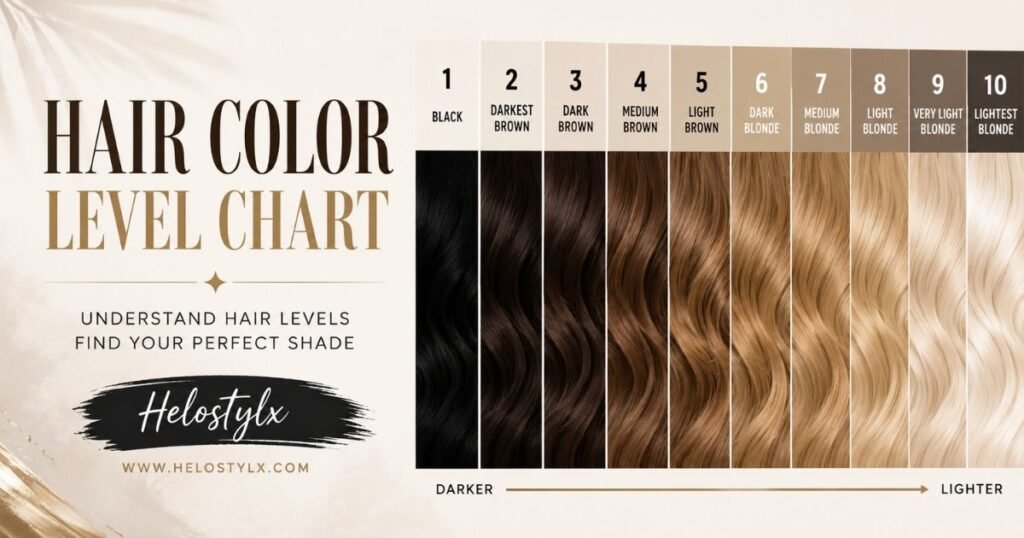
If you’ve ever sat in a salon chair and heard your colorist say “let’s take you to a level 6,” you’ve bumped into one of the best-kept secrets of professional hair color: the hair color levels system. Every shade you’ve ever worn — from jet black to platinum — has a number attached to it, and that number tells you exactly how light or dark it is, regardless of the brand name on the box or bottle.
This guide breaks down the full hair color levels chart, from level 1 to level 10, so you can walk into any salon (or approach your next box dye) speaking the same language as a professional colorist.
How the 10-Level System Works
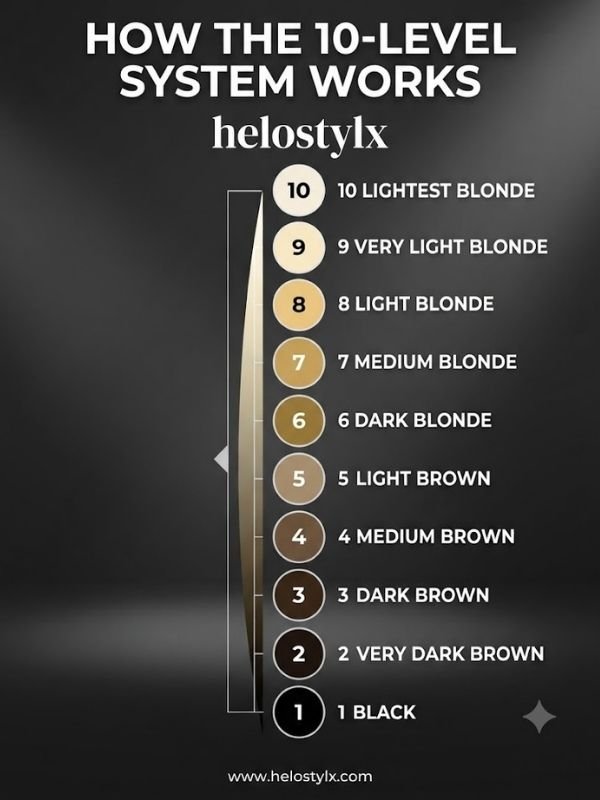
Professional colorists don’t think in terms of “chocolate brown” or “honey blonde.” They think in numbers. The hair color level chart 1-10 is a universal scale that measures the lightness or darkness of a hair shade, independent of its tone (the warm or cool undertone).
Here’s the logic:
- Level 1 is the darkest possible shade — true black.
- Level 10 is the lightest — pale, almost white-blonde.
- Every level in between represents a measurable step up in lightness, achieved by lifting (lightening) the natural pigment in the hair.
This numbering exists because color names are inconsistent across brands. “Chestnut brown” from one company might match “level 5” from another, but the level number never lies. That’s why every professional hair color chart — whether it’s Wella, L’Oréal, Redken, or Schwarzkopf — is built on this same 10-step foundation.
Understanding hair color levels also helps you predict outcomes. If your natural hair is a level 4 and you want a level 8 blonde, you already know you’re lifting four levels, which means bleach or a high-lift formula, not just a demi-permanent gloss. This single concept prevents more color disasters than almost anything else in hairdressing.
Below, we’ll walk through each level one by one, covering the tone families available at that level, real brand examples, the underlying pigment you’ll need to neutralize, and how to actually reach that shade.
Hair Color Level 1: Black
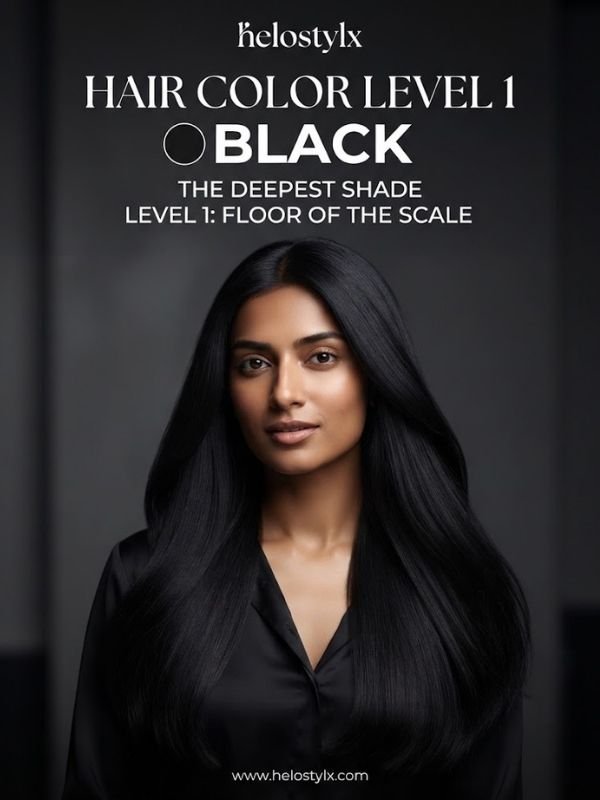
Level 1 is the deepest, most saturated shade on the entire hair color levels chart. There is no lighter or darker version of true black — it’s the floor of the scale.
Available Tone Families
Level 1 doesn’t have much tonal variation because there’s so little light reflecting off the hair shaft. You’ll mostly see:
- Natural/neutral black — pure, flat black with no visible warmth or coolness
- Blue-black — black with a cool, almost violet-blue sheen, popular in Asian and fashion color circles
- Soft black — a slightly less dense black often used to avoid harsh, “helmet” looking color
Professional Brand Examples
- Wella Koleston Perfect 1/0 (Black)
- L’Oréal Professionnel Majirel 1
- Redken Color Fusion 1N
- Schwarzkopf Igora Royal 1-0
Underlying Pigment & Neutralization
Level 1 hair has virtually no visible underlying pigment because the shade sits at the deepest point of the scale — the natural melanin dominates completely. There’s essentially nothing to neutralize here; the challenge is usually the opposite problem, lifting out of level 1 later without hitting muddy, ashy tones.
Hair Color Level 2: Very Dark Brown
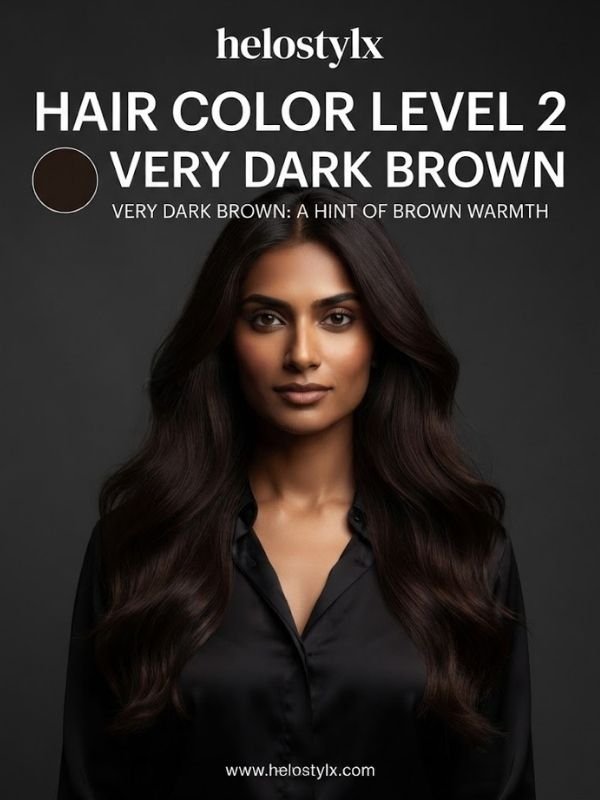
Level 2 is often confused with black, but it carries a faint hint of brown warmth when it catches direct light — something true black never does.
Available Tone Families
- Natural — soft, brown-black with minimal reflect
- Cool/Ash — used to counteract any red undertone in very dark natural hair
- Warm/Red-brown — a subtle mahogany cast for dimension
Professional Brand Examples
- Wella Koleston Perfect 2/0
- Matrix SoColor 2N
- Redken Color Fusion 2NN
- Goldwell Topchic 2N
Underlying Pigment & Neutralization
At level 2, the underlying pigment is a very dark red-brown. If you’re lifting natural level 2 hair even slightly, you’ll start to see faint red tones emerge, which is why colorists often add a small amount of ash or blue-based toner to keep things looking clean rather than muddy.
How to Reach Level 2
- Use a permanent color formulated at 2/0 or 2N directly on level 1-3 natural hair
- If covering gray, choose a natural-based formula (not a double-pigmented one) to avoid an unnatural flat result
- Process time is typically 30-35 minutes with a 20-volume developer for gray coverage
Hair Color Level 3: Dark Brown
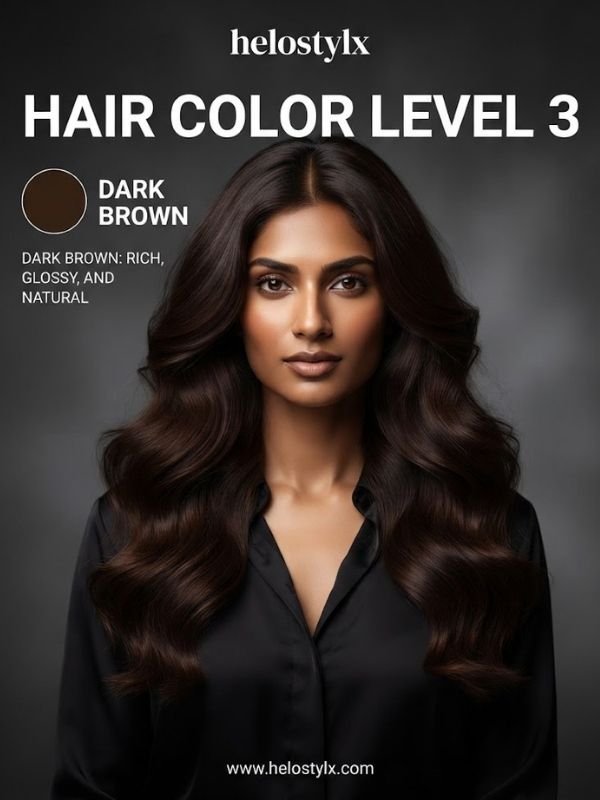
Level 3 is one of the most requested natural-looking brunette shades because it reads as rich and glossy without looking severe.
Available Tone Families
- Natural brown — balanced, everyday brunette
- Cool/Ash brown — neutralizes red for a more matte finish
- Warm/Golden brown — adds richness and shine
- Red/Auburn — deep burgundy-brown fashion shades
Professional Brand Examples
- Wella Koleston Perfect 3/0
- L’Oréal Professionnel Majirel 3
- Matrix SoColor 3N
- Igora Royal 3-0
Underlying Pigment & Neutralization
The natural underlying pigment at level 3 is red-orange. Colorists frequently mix in a small percentage of ash (blue/green base) to keep the finished color from developing a coppery cast, especially on hair that’s been previously colored or has resistant gray.
How to Reach Level 3
- Apply a 3N or 3.0 permanent formula with 20-volume developer on virgin level 2-4 hair
- For gray coverage above 30%, use a natural or natural-warm base to hold pigment longer
- Add a 30-minute processing check, since dark brown formulas can grab quickly on porous hair
Hair Color Level 4: Medium Brown
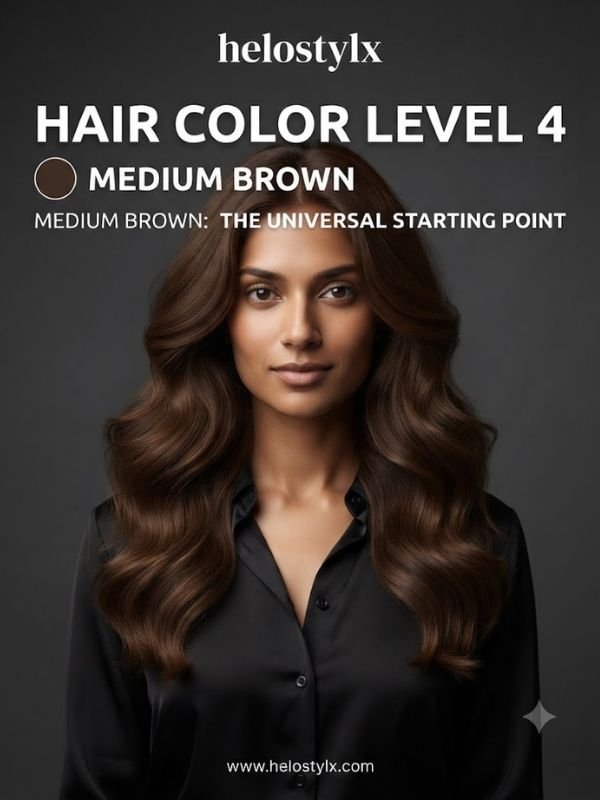
Level 4 is the most common natural hair level worldwide, which makes it a favorite starting point on any professional hair color chart.
Available Tone Families
- Natural — true, balanced medium brown
- Ash — cool-toned, ideal for neutralizing brassiness
- Golden/Warm — sun-kissed, honey-brown finish
- Copper/Red — vibrant auburn and copper-brown fashion tones
- Chocolate/Mahogany — deep, glossy brown with red-violet depth
Professional Brand Examples
- Wella Koleston Perfect 4/0
- Redken Color Fusion 4NW
- Matrix SoColor 4N
- Schwarzkopf Igora Royal 4-65 (Chocolate)
Underlying Pigment & Neutralization
Level 4’s underlying pigment is orange. This is the level where brassiness starts to become a real conversation — any lightening service on level 4 hair needs a toner or filler that leans blue-based to counteract that orange cast.
How to Reach Level 4
- For a natural look, use 4N with 20-volume developer for 30-35 minutes
- Going from level 4 to level 4 with a tonal change (e.g., natural to ash) only needs a demi-permanent gloss
- If lifting from a darker natural level, confirm your formula includes enough lift (10-volume won’t move levels, 20-volume typically lifts 1-2 levels)
Hair Color Level 5: Light Brown
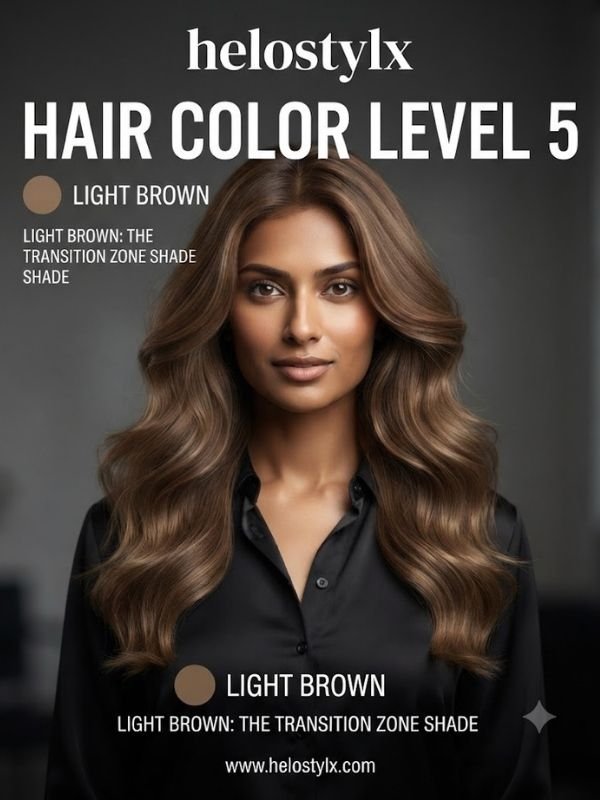
Level 5 sits right at the transition zone — light enough to look sun-touched, dark enough to stay low-maintenance.
Available Tone Families
- Natural — soft, neutral light brown
- Ash — smoky, cool light brown popular for covering brassiness
- Golden — warm caramel-toned brown
- Red/Copper — vibrant strawberry-brown and copper fashion shades
- Beige — a muted blend of ash and gold, very on-trend
Professional Brand Examples
- Wella Koleston Perfect 5/0
- L’Oréal Professionnel Majirel 5.3
- Matrix SoColor 5N
- Goldwell Topchic 5A (Ash)
Underlying Pigment & Neutralization
The dominant underlying pigment shifts to orange-red at level 5. Colorists often reach for beige or ash-based formulas here because level 5 is notorious for brassiness rebound between salon visits.
How to Reach Level 5
- Use 5N with 20-volume developer for a natural result on level 4-6 hair
- To lighten from level 3-4 natural hair, use 30-volume developer and expect one to two levels of lift
- Always apply a color-safe conditioning treatment post-processing, since level 5 formulas often use more oxidative dye load
Hair Color Level 6: Dark Blonde
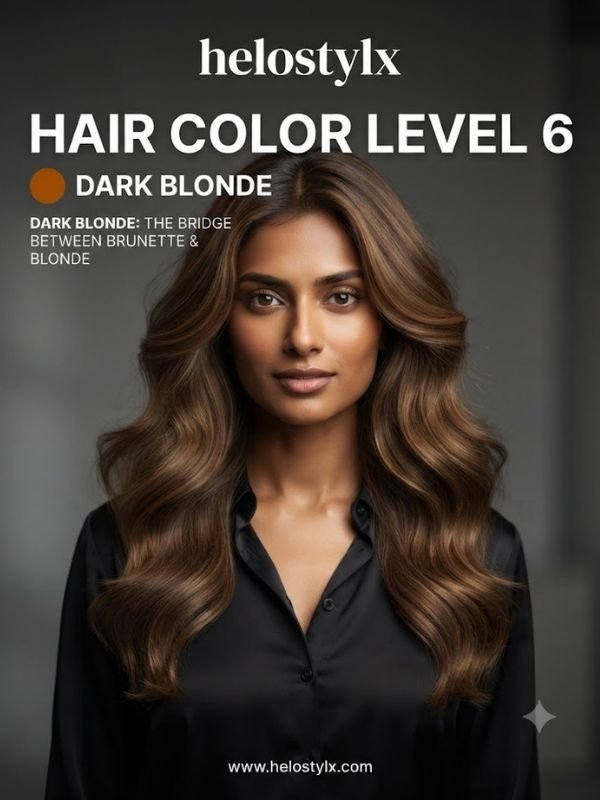
Level 6 is the bridge between brunette and blonde — sometimes called “dirty blonde” in casual conversation, but it’s a precise, popular shade on the hair color levels chart.
Available Tone Families
- Natural — soft, ashy-neutral dark blonde
- Golden — warm, honey-toned blonde
- Ash — cool, smoky dark blonde
- Red/Copper — vibrant strawberry-blonde tones
- Chocolate — a brown-blonde crossover with warm depth
Professional Brand Examples
- Wella Koleston Perfect 6/0
- Redken Color Fusion 6NA
- Matrix SoColor 6N
- Igora Royal 6-00
Underlying Pigment & Neutralization
Underlying pigment at level 6 is orange, trending toward yellow-orange. This is the level where colorists start reaching for violet-based toners on the yellow side and blue-based correction on the orange side, depending on the client’s natural undertone.
How to Reach Level 6
- Lifting from a natural level 4 typically requires 30-volume developer and a lightening or high-lift formula
- For gray coverage at level 6, use a 6N or 6.0 base to anchor pigment and prevent fading to a dull, washed-out tone
- Expect roughly 35-45 minutes of processing time depending on developer strength
Hair Color Level 7: Medium Blonde
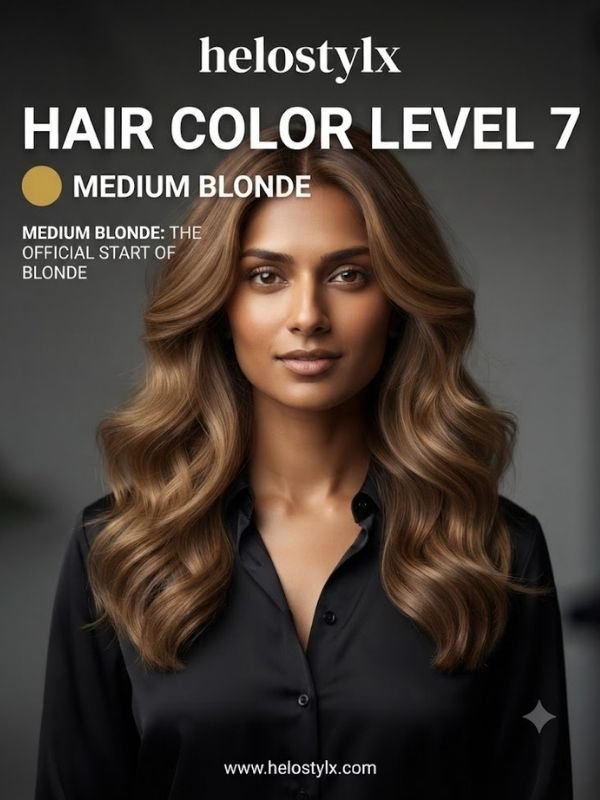
Level 7 is where things officially become “blonde,” and it’s one of the most requested shades for clients wanting warmth without going platinum.
Available Tone Families
- Natural — balanced, believable medium blonde
- Ash — cool-toned, ideal for neutralizing yellow
- Golden/Honey — warm, dimensional blonde
- Beige — muted, low-maintenance blend
- Red/Strawberry — copper-kissed blonde tones
Professional Brand Examples
- Wella Koleston Perfect 7/0
- L’Oréal Professionnel Majirel 7.1
- Matrix SoColor 7N
- Schwarzkopf Igora Royal 7-4 (Beige)
Underlying Pigment & Neutralization
The underlying pigment here is yellow-orange. Toners with violet or blue-violet pigment are essential to keep level 7 blonde from reading brassy, especially since this level processes quickly and can overshoot warmth if left unchecked.
How to Reach Level 7
- Use high-lift permanent color or a lightening service (foils/balayage) with 30-40 volume developer
- Always follow with a toning step — a level 7 result almost never looks finished without one
- If starting from level 5-6 natural hair, one lightening session is usually enough; darker starting levels may need double-process
Hair Color Level 8: Light Blonde
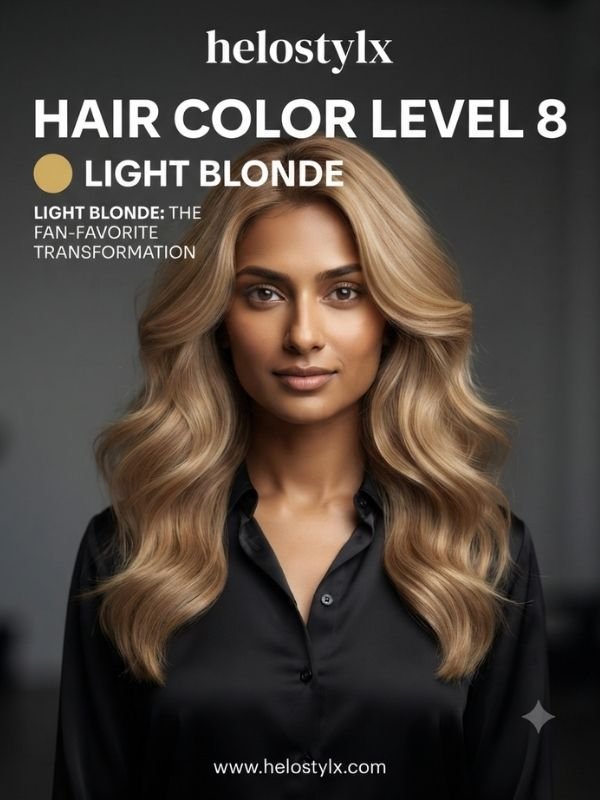
Level 8 is a fan-favorite among the hair color levels because it’s light enough to feel like a real transformation but still achievable without severe damage for many hair types.
Available Tone Families
- Natural — soft, neutral light blonde
- Ash — icy, cool-toned blonde
- Golden — warm, buttery blonde
- Beige — trendy, muted neutral-warm blend
- Violet/Pearl — cool, luminous blonde with a lavender cast
Professional Brand Examples
- Wella Koleston Perfect 8/0
- Redken Color Fusion 8NA
- Matrix SoColor 8N
- Goldwell Topchic 8P (Pearl)
Underlying Pigment & Neutralization
Underlying pigment shifts to yellow at level 8. A violet-based toner is the standard correction tool here, since yellow and violet sit opposite each other on the color wheel and cancel each other out.
How to Reach Level 8
- Lightening service required for most natural levels below 6; expect lightener plus a toning gloss
- Use 30-40 volume developer with lightener, monitored closely to avoid overprocessing
- A bond-building treatment (like Olaplex or K18) during the lightening process is strongly recommended to preserve hair integrity
Hair Color Level 9: Very Light Blonde
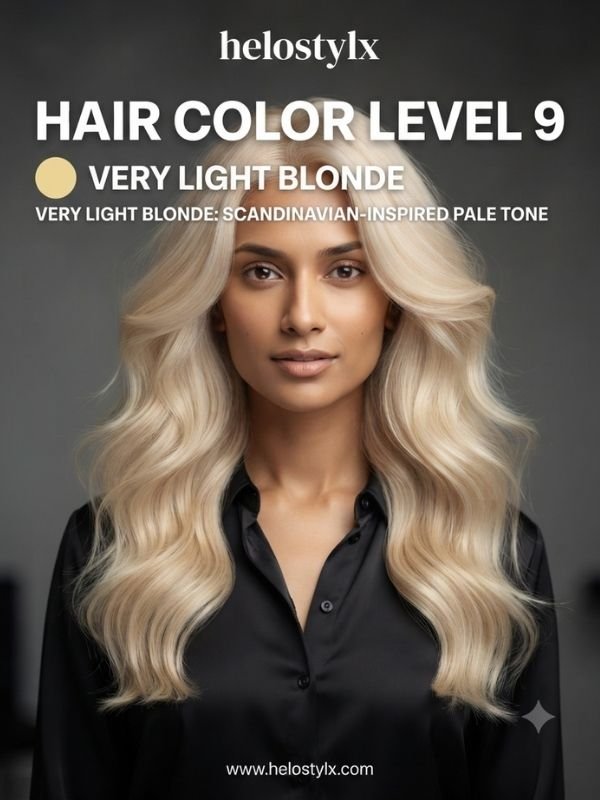
Level 9 pushes into pale blonde territory, often requested for a soft, Scandinavian-inspired finish.
Available Tone Families
- Natural — soft, low-warmth pale blonde
- Ash — very cool, almost silvery blonde
- Golden — pale champagne-blonde with warmth
- Violet/Pearl — cool-toned with a subtle lavender sheen
- Beige — neutral pale blonde, popular for low-maintenance grow-out
Professional Brand Examples
- Wella Koleston Perfect 9/0
- L’Oréal Professionnel Majirel 9.1
- Matrix SoColor 9N
- Igora Royal 9-00
Underlying Pigment & Neutralization
At level 9, underlying pigment is pale yellow. Even a small amount of unwanted warmth is highly visible at this level, so precise toning with violet or blue-violet pigments is non-negotiable for a clean result.
How to Reach Level 9
- Requires lightening (bleach or high-lift) for almost all natural hair colors except those already at level 7-8
- Follow lightening with a toner formulated specifically for pale blonde correction
- Deep conditioning and bond repair are essential — level 9 is at the upper edge of what most hair can handle without significant damage
Hair Color Level 10: Lightest Blonde
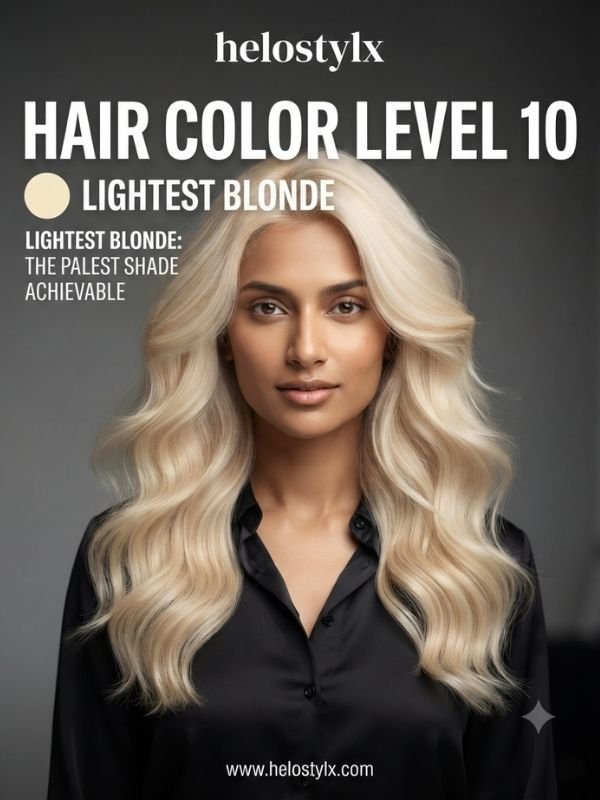
Level 10 is the top of the hair color level chart 1-10 — the palest, most delicate shade achievable.
Available Tone Families
- Natural — extremely pale, almost white-blonde
- Ash/Platinum — ultra-cool, silvery-white finish
- Pearl/Violet — icy blonde with a soft lavender undertone
- Golden — rare at this level, a very pale champagne warmth
Professional Brand Examples
- Wella Koleston Perfect 10/0
- Redken Color Fusion 10NA
- Matrix SoColor 10N
- Goldwell Topchic 10P (Pearl)
Underlying Pigment & Neutralization
The underlying pigment at level 10 is pale yellow, bordering on colorless. Because there’s so little pigment left to work with, even trace warmth needs immediate violet-based correction to achieve that coveted platinum finish.
How to Reach Level 10
- Almost always requires bleach lightening, sometimes in multiple sessions spaced weeks apart for hair health
- A toner is mandatory — raw lightened hair at level 10 always carries some yellow that needs neutralizing
- This level demands the most aftercare: purple shampoo, weekly bond treatments, and heat protection to prevent breakage
Blonde Hair Color Chart: Levels 7 to 10
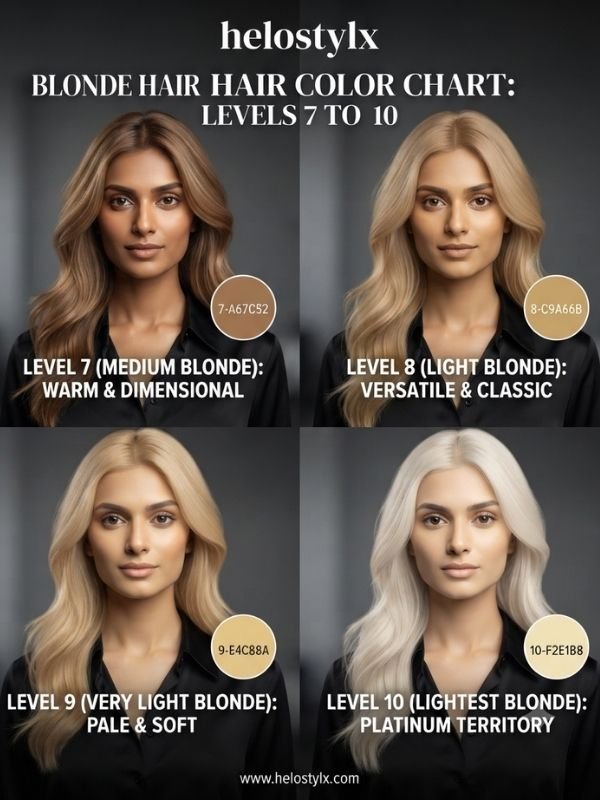
If blonde is your goal, levels 7 through 10 are your playground. Here’s the quick-reference breakdown:
- Level 7 (Medium Blonde): Warm, dimensional, achievable with high-lift color on many natural bases
- Level 8 (Light Blonde): A classic, versatile blonde that suits most skin tones with the right tone family
- Level 9 (Very Light Blonde): Pale and soft, best suited for lighter starting levels or committed lightening plans
- Level 10 (Lightest Blonde): Platinum territory — beautiful, but the highest-maintenance shade on the entire chart
Moving up this range always means more lightening and more toning. The further you go, the more important professional guidance becomes to protect hair health.
Brown Hair Color Chart: Levels 3 to 6
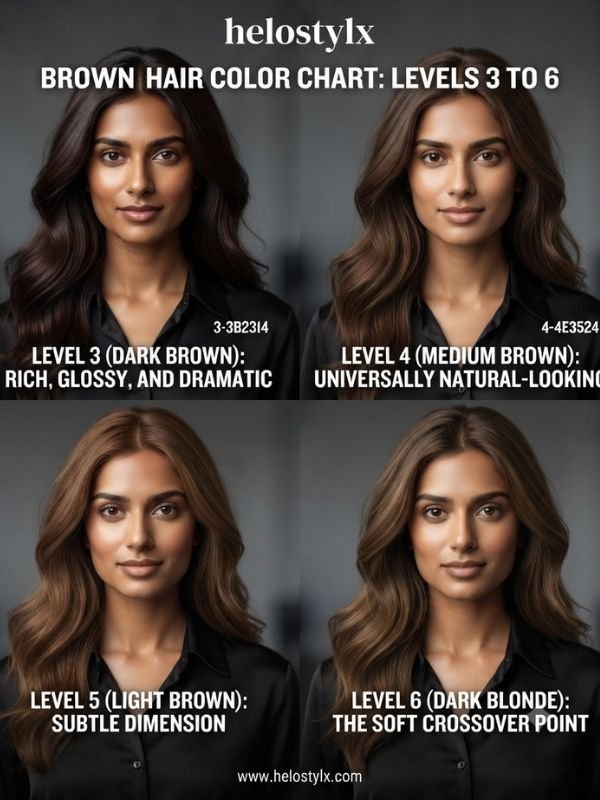
Brunettes have just as much range as blondes, and levels 3 through 6 cover nearly every shade of brown imaginable:
- Level 3 (Dark Brown): Rich, glossy, and dramatic — great for deep contrast
- Level 4 (Medium Brown): The most universally natural-looking brunette shade
- Level 5 (Light Brown): Sun-warmed and low-maintenance, popular for subtle dimension
- Level 6 (Dark Blonde): The soft crossover point where brown starts to read as blonde
This range is forgiving for grow-out and gray coverage, which is part of why it remains the most requested zone on any professional hair color chart.
Reflect Families: What .0, .1, .3 Mean
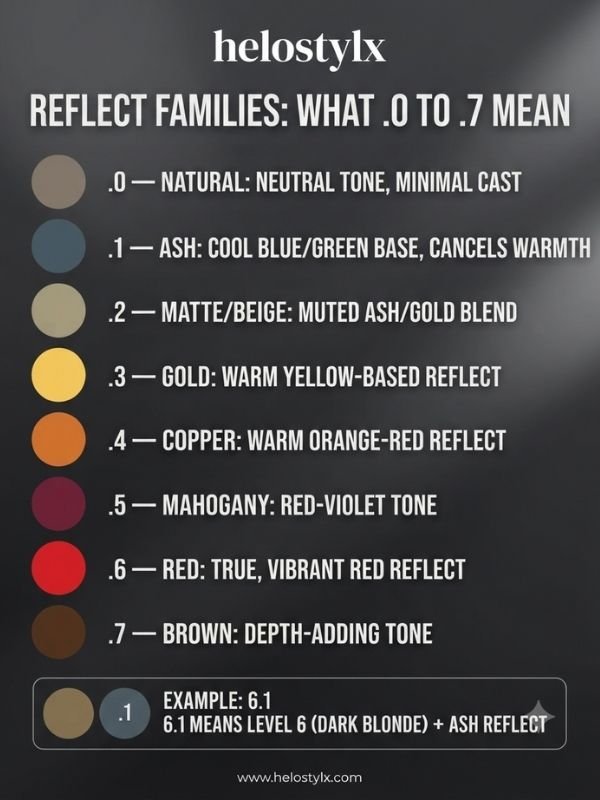
Every level on the hair color levels chart pairs with a “reflect” or tone number, usually written after a decimal point or slash. These numbers tell you the undertone of the shade:
- .0 — Natural, neutral tone with minimal warm or cool cast
- .1 — Ash, a cool blue or green-based tone used to cancel warmth
- .2 — Matte or beige, a muted blend of ash and gold
- .3 — Gold, a warm yellow-based reflect
- .4 — Copper, a warm orange-red reflect
- .5 — Mahogany, a red-violet reflect
- .6 — Red, a true, vibrant red reflect
- .7 — Brown, sometimes used as a depth-adding reflect in blonde formulas
So when a colorist says “6.1,” they mean level 6 (dark blonde) with an ash reflect — cool-toned and de-brassed. Understanding this two-part code is the real key to reading any professional hair color chart with confidence, because it separates “how light” from “what color family.”
Questions About Hair Color Levels
What is the difference between hair color levels and hair color tones?
Level measures how light or dark a shade is (1-10), while tone describes its warm or cool undertone.
How do I find out my natural hair color level?
Check your hair in natural daylight against a professional hair color chart swatch, or ask your colorist to identify it in seconds.
Can I lighten my hair more than four levels at home?
It’s risky — lifting more than 3-4 levels at once often causes damage and brassiness, so professionals split it across sessions.
Why does my hair color always turn brassy after a few weeks?
The underlying pigment at every level resurfaces as toner fades, which is why purple/blue shampoo and regular glosses are essential.
Final Thoughts
Mastering hair color levels turns hair color from a guessing game into a genuine science. Whether you’re chasing a soft level 4 brunette or a dramatic level 10 platinum, knowing where your starting level sits — and where you want to land — is the single most useful piece of information you can bring into a salon consultation. Keep this hair color levels chart handy, and you’ll never leave a color appointment confused about what “level” actually means again.
