

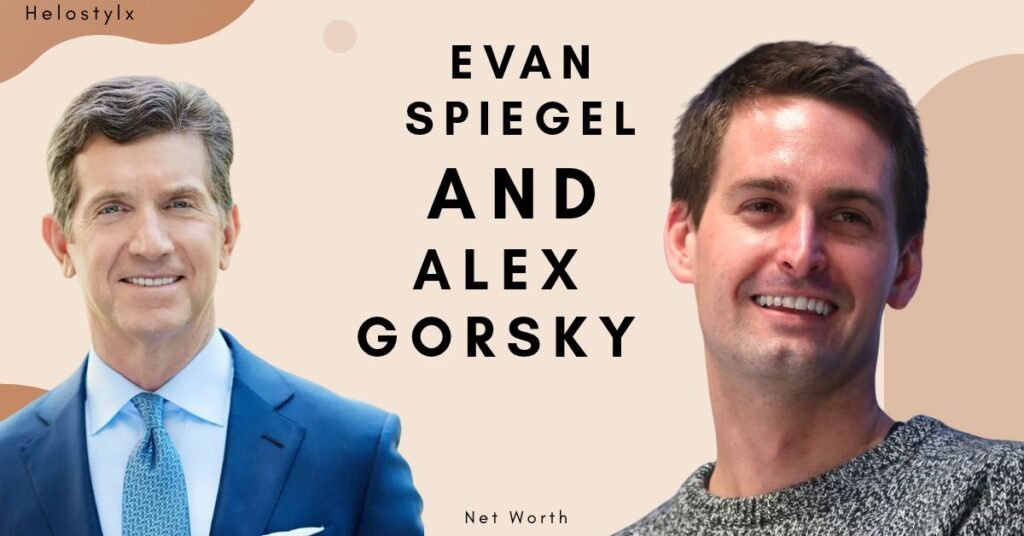
Evan Spiegel co-founded Snap Inc. and still runs it, with voting control that outside shareholders cannot override. Alex Gorsky worked his way up through Johnson & Johnson, led it as CEO from 2012 until January 2022, and now sits on the boards of Apple, IBM and JPMorgan Chase. Nothing in the public record shows a family tie, a joint company or a shared investment between them. The overlap that can be verified is institutional: The Business Council’s published member list carries both names.
Key takeaways
- Spiegel built a company while still a Stanford student. Gorsky was an Army officer, then a pharmaceutical sales rep, then a CEO. Same destination, almost opposite routes.
- Snap’s third quarter of 2026 brought revenue of $1.72 billion (up 14%) and a $56 million profit, yet only 92 million of its 495 million daily users, those in North America, produced about 59% of that revenue (our calculation from Snap’s own table).
- Advertising grew just 4%, while subscriptions and other revenue grew 84%. Snap now counts more than 30 million paying subscribers.
- Gorsky’s board seats at Apple and JPMorgan each paid roughly $415,000 in the most recent disclosed years.
- The real connection between the two men is membership in The Business Council. Details, and the limits of what the record shows, are in the section “Where their paths meet.”
Evan Spiegel and Alex Gorsky at a glance
| Evan Spiegel | Alex Gorsky | |
| Born | June 4, 1990, Los Angeles | May 24, 1960, Kansas City, Kansas |
| Age (November 2026) | 36 | 66 |
| Education | Stanford, B.S. in Engineering (Product Design). Left in 2012, finished in 2018 | West Point, B.S. (1982). Wharton MBA (1996) |
| Starting point | Building Snapchat as a student (2011) | Army officer, then Janssen sales rep (1988) |
| Biggest title | Co-founder and CEO of Snap Inc.; also leads Specs Inc. | Chairman and CEO of Johnson & Johnson (CEO from April 2012, chairman from December 2012) |
| Today | Runs Snap; sits on the Berggruen Institute and Crossroads School boards | Director at Apple, IBM and JPMorgan Chase; General Partner at ICONIQ Capital |
| Who can overrule him | Practically nobody: he and co-founder Bobby Murphy hold over 99% of the votes | As CEO, the J&J board and shareholders. As a director today, he is one of the people doing the overruling |
Evan Spiegel: from a class project to a company that has to prove itself again
Spiegel was born on June 4, 1990, in Los Angeles and grew up in Pacific Palisades. Both of his parents were lawyers. At Stanford he studied product design and, through a fraternity, got to know Bobby Murphy, the person who would become his co-founder and Snap’s chief technology officer.
The app took shape in 2011 under the name Picaboo. The original concept is credited to Reggie Brown, a fraternity brother; Brown was later pushed out, sued, and settled out of court, with the payout reported at about $158 million. Spiegel walked away from Stanford in 2012, a short distance from graduating, and collected his degree in 2018.
Snap went public in March 2017, raising about $3.4 billion at a valuation near $24 billion. The twist was in the share structure: the stock sold to the public carried no votes at all. Spiegel and Murphy hold the Class C shares, which carry ten votes each, and a 2023 company filing put their combined voting power above 99%.
That detail explains a lot of what follows. A CEO who cannot be outvoted can make unpopular moves quickly, whether that means cutting a sixth of the workforce or spending heavily on a hardware product nobody has proven demand for. It also means the market’s patience is the only real check on him.
Snap in 2026: what the third-quarter numbers say
Snap reported its Q3 2026 results on November 4. Here is the core scorecard, taken from the company’s own release and supplemental tables:
| Metric | Q3 2026 | Q3 2025 | Change |
| Revenue | $1,722M | $1,507M | +14% |
| Net income | $56M | –$104M | Swing to profit |
| Adjusted EBITDA | $383M | $182M | +110% |
| Free cash flow | $164M | $93M | +76% |
| Daily active users | 495M | 477M | +4% |
| Monthly active users | 977M | 943M | +4% |
| North America daily users | 92M | 98M | –6% |
| North America revenue per user | $11.07 | $9.20 | +20% |
| Full-time employees | 4,540 | 5,194 | –13% |
A few things hide behind those rows.
Revenue depends on a small slice of users. By our arithmetic, North America supplied about 19% of daily users (92 of 495 million) but roughly 59% of revenue ($1,014 million of $1,722 million). Rest of World was the opposite: about 62% of users and 20% of revenue. North American growth came from earning more per person, not from adding people. Daily users there have fallen year over year in each of the six quarters Snap lists.
The revenue mix is changing under everyone’s feet. Advertising rose only 4%, to about $1.37 billion. Other revenue, driven by Snapchat+, Lens+ and paid Memories storage, jumped 84% to roughly $350 million, which is now about one dollar in five. Snap says it has passed 30 million paying subscribers, up five million since February. Spiegel acknowledged that ad growth fell short of what he wanted; direct-response campaigns did well while brand advertising declined.
The cost reset is visible in the headcount. In April, Snap announced it would cut about 1,000 jobs (16% of staff) and close more than 300 open roles, citing AI-driven efficiency. The company said the moves would lower its annualized cost base by over $500 million by the second half of 2026. Through nine months, restructuring charges came to $128.5 million. Longtime CFO Derek Andersen left in May, and Doug Hott took over. Even after the Q3 profit, the nine-month figure is still a net loss of about $196 million, so the picture is improving rather than settled.
Snap will soon change how it reports users. Starting with Q1 2027 results, monthly active users replace daily active users as the headline metric. Snap’s stated reasoning is that it does not want to optimize the app around daily use at the expense of long-term value. The timing is worth watching, because daily user growth had slowed to a crawl: DAU rose only two million from the prior quarter and landed below analyst estimates.
Then there is Specs. Snap unveiled its consumer AR glasses at AWE on June 16, 2026, at $2,195, with a $200 refundable preorder deposit and shipping this fall in the United States, United Kingdom and France. Reporting points to an initial run of around 100,000 units. Snap says four million Lenses will work on the device at launch. For scale, Apple’s Vision Pro costs $3,499 and Meta’s glasses range from $379 to $799. One open question from the announcement: Snap did not confirm at the time whether the Snapchat app itself would be available on Specs. Spiegel has described the glasses as the company’s long-term bet on a computing platform beyond the smartphone.
Alex Gorsky: the long climb
Gorsky was born on May 24, 1960. He graduated from West Point in 1982 and spent six years in the U.S. Army, leading an artillery platoon at 22 and finishing as a captain with Ranger and Airborne qualifications, after postings in Europe, the U.S. and Panama.
In 1988 he left the service and joined Janssen Pharmaceutica, part of Johnson & Johnson, as a sales representative. The steps after that, in order:
- 2001: president of Janssen
- 2003: head of J&J’s pharmaceutical business for Europe, the Middle East and Africa
- 2004: left for Novartis, where he ran the North American pharmaceuticals business
- 2008: returned to J&J as head of Ethicon, in medical devices
- 2009: worldwide chairman of the Surgical Care Group and a seat on the executive committee
- 2011: vice chairman
- April 26, 2012: named CEO
- December 28, 2012: named chairman
He earned a Wharton MBA in 1996, while his career was already well underway. J&J counts him as one of only seven people to hold the combined chairman and CEO job since the company listed on the NYSE in 1944.
What happened on his watch (2012 to 2022)
Deals and reputation. The Synthes acquisition closed in his first year as CEO. A later purchase, Actelion, was credited by analysts with adding nearly eight points to pharmaceutical growth in a single quarter. J&J appeared on Fortune’s Most Admired Companies list in every year he was CEO. In Q3 2021, one of his last quarters in charge, sales reached $23.3 billion, up 10.7%.
The vaccine chapter. This is the part of his tenure most people remember, and it was not a straight line:
- On February 27, 2021, the FDA granted emergency authorization to the single-dose Janssen COVID-19 vaccine.
- On April 13, U.S. health agencies recommended a pause after six reported cases of a rare clotting disorder combined with low platelets.
- On April 23, the CDC’s advisory committee voted 10 to 4 to resume use. By April 21, about 7.98 million doses had been given in the U.S.
- The FDA later narrowed the authorization after further analysis of that clotting syndrome.
The handoff. J&J announced in August 2021 that Gorsky would pass the CEO role to Joaquin Duato at the start of 2022. Gorsky cited family health reasons, and the board’s lead director framed it as planned succession. He stayed on as executive chairman until January 2023.
After J&J: from operator to overseer
Gorsky’s second act is on the other side of the table. He became an Apple director on November 9, 2021, and serves on its nominating and people-and-compensation committees. He has been an IBM director since 2014, and company profiles list him as lead independent director there. He joined JPMorgan Chase’s board in July 2022. He is also a General Partner at ICONIQ Capital, a co-founder of Alderline Group, chairman emeritus of the American Heart Association’s CEO Roundtable, and a fellow at the George W. Bush Institute.
The pay for two of those seats is public. Apple reported 416,492intotaldirectorcompensationforfiscal2025(100,000 in cash, $310,035 in stock awards and $6,457 in other compensation). JPMorgan reported $415,000 for 2024. The two disclosures cover different years, so treat the roughly $830,000 combined as a ballpark.
Also Read This : Sam Zell and Nicole Kidman: How a Property Contrarian and a Risk-Taking Actor Built Lasting Careers
Where their paths meet, and where they don’t
What can be verified. The Business Council publishes a member list. Spiegel appears on it as CEO of Snap Inc., and Gorsky appears as former CEO and chairman of Johnson & Johnson. Spiegel’s own biographies also list him as a member of the Business Roundtable.
What is murkier. Gorsky sat on the Business Roundtable’s board and chaired its corporate governance committee while he led J&J. The Roundtable is a group for sitting CEOs, so his current status is unclear, and the public record does not show when Spiegel’s membership began. We can’t say the two overlapped there.
What is not established. No family relationship, joint venture, shared investment or direct working partnership has been documented. Any article claiming otherwise is guessing.
Leadership compared
| Spiegel | Gorsky | |
| How he got the job | Founded the company | Climbed for two decades across two stints at J&J |
| Who can overrule him | Essentially no one | The board and shareholders (as CEO) |
| Biggest test | Slowing user growth, a lopsided revenue base, an expensive AR bet | Scale, litigation-heavy industry, a vaccine launched under pressure |
| Playbook | Cut costs, monetize subscribers, bet on hardware | Broad portfolio, large acquisitions, planned succession |
| What winning looks like now | Durable profit and a Specs product people actually buy | Sound oversight at three of the largest companies in the world |
The sharpest contrast is accountability. Spiegel’s structure lets him play a very long game, and it also removes the usual outside pressure. Gorsky spent a decade answering to a board and now sits on boards that question CEOs for a living. Neither arrangement is automatically better. They produce different kinds of discipline, one internal and one imposed.
What readers can take from both careers
- Product instinct and institutional judgment are different skills. Spiegel’s strength is deciding what people will want. Gorsky’s was running a very large organization through regulation, acquisitions and a global health emergency.
- A hit product does not guarantee a stable business. Snap needed years to reach consistent profitability and is still shifting from advertising toward subscriptions.
- Long careers get built in layers. Gorsky’s route runs through sales, a rival company, a return and a series of promotions. Nobody skipped the middle.
- Read the structure, not just the title. Two CEOs can hold the same job and operate under completely different rules.
Net worth: why every figure you see is different
Spiegel’s wealth is mostly Snap stock, so any estimate is a snapshot that moves with the share price. Reports citing Forbes put him at roughly $2.1 to $2.3 billion in 2026. Trackers built only from SEC insider filings show a far lower number, since they count shares reported directly and say so in their own disclaimers. Much higher figures, in the $5 billion to $13 billion range, circulate on low-quality aggregator sites and do not match the Forbes-based numbers above, even when they name Forbes as their source. Treat them with caution. For Gorsky, no credible public estimate exists, so we don’t offer one.
Frequently asked questions
Are Evan Spiegel and Alex Gorsky related or business partners?
No. Nothing in the public record shows a family tie, a joint company or a shared investment. The documented overlap is membership in The Business Council, whose member list includes both.
What do Evan Spiegel and Alex Gorsky have in common?
Both have led large public companies, both appear on The Business Council’s member list, and both have been associated with the Business Roundtable. Beyond that their careers differ sharply: one is a founder with outsized voting control, the other a career executive turned corporate director.
Who is Alex Gorsky?
A West Point graduate and former Army captain who joined Johnson & Johnson in 1988, became CEO in April 2012 and chairman in December 2012, and passed the CEO role to Joaquin Duato in January 2022. He now serves on the boards of Apple, IBM and JPMorgan Chase.
What does Evan Spiegel do today?
He is co-founder and CEO of Snap Inc., which makes Snapchat, and also leads Specs Inc., the subsidiary behind Snap’s AR glasses. In Q3 2026 Snap reported 495 million daily and 977 million monthly active users.
How much is Evan Spiegel worth in 2026?
Reports citing Forbes put it around $2.1 to $2.3 billion, but the figure swings with Snap’s share price. Trackers based only on SEC filings show much lower totals. Treat every number as an estimate.
When did Alex Gorsky stop being CEO of Johnson & Johnson?
He handed the CEO role to Joaquin Duato in January 2022, after announcing the change in August 2021. He then served as executive chairman until January 2023.
Which boards does Alex Gorsky sit on?
Apple (since November 2021), IBM (since 2014) and JPMorgan Chase (since July 2022), plus several non-profit boards.
Is Snap profitable in 2026?
Snap posted $56 million in net income in Q3 2026, but the first nine months of the year still show a net loss of about $196 million. The trend is improving; the year is not yet in the black.
Sources
- Snap Inc. Q3 2026 financial results (Business Wire release via Seeking Alpha)
- Snap Q3 2026 earnings call highlights (Nasdaq/MarketBeat)
- Snap Q3 guidance and Specs commentary (MarketBeat)
- Snap ad revenue and subscription growth (PPC Land)
- Snapchat passes 30M paid subscribers (TechCrunch)
- Snapchat Q3 user growth (Social Media Today)
- Snap Q3 ad growth below expectations (MediaPost)
- Snap cuts 1,000 jobs (TechCrunch, April 2026)
- Snap organizational changes and cost savings (Snap Newsroom)
- Snap CFO transition (Pulse 2.0)
- Snap Specs price and launch details (VR.org)
- Specs production run reporting (iDevice roadmap)
- Specs vs Vision Pro and Meta pricing (GV Wire)
- Snap’s dual-class voting power (SEC 8-K via CapEdge)
- Snap IPO structure (New York Post via PressReader)
- Who owns Snapchat (BGR)
- Evan Spiegel founder story (Flexiple)
- Evan Spiegel profile (Economic Strategy Group)
- Evan Spiegel on Business Roundtable
- Evan Spiegel net worth estimates (Companies History)
- Gen Z billionaires report (Investormint)
- Evan Spiegel insider holdings (Quiver Quantitative)
- Alex Gorsky career summary (J&J 8-K, SEC)
- J&J CEO succession news (MassDevice)
- J&J Q3 2021 results
- Alex Gorsky biography (Thayer Leader Development Group)
- Alex Gorsky (George W. Bush Institute)
- Alex Gorsky (Wikipedia)
- Apple board announcement (Business Wire)
- Gorsky board roles (MarketScreener)
- Gorsky at Apple, compensation (VectorShift)
- Gorsky at JPMorgan, compensation (Fintool)
- CDC MMWR on Janssen vaccine pause
- FDA memo on revised Janssen authorization
- Business Council member list, G
- Business Council member list, S
- Business Roundtable 2018 board announcement
